

This is part of the Walking the Narrow Road Road: A Year with The Pilgrim’s Progress
There are moments in the Christian life when what we need most is not encouragement, at least not the kind we usually ask for. What we really need is clarity. The kind that does not make things easier, but makes them honest.
Most of us live a long time assuming we are doing fairly well. Not perfect, of course, but decent. We compare ourselves to people who seem worse than we are. We measure by effort instead of holiness. We tell ourselves that we mean well, and for a while that feels like enough.
Until the truth starts to get through.
That is where Bunyan brings Christian in Interpreter’s House. The journey has begun, but it cannot really continue until Christian understands something about himself that he would never have learned on the road alone. Grace will not make sense to him until he understands why he needs it. And that means he has to see what sin actually does, not in theory, but in the heart.
Interpreter does not give him a lecture. He shows him a picture. And it is one of the most painfully accurate pictures Bunyan ever wrote.
The room that could not be cleaned
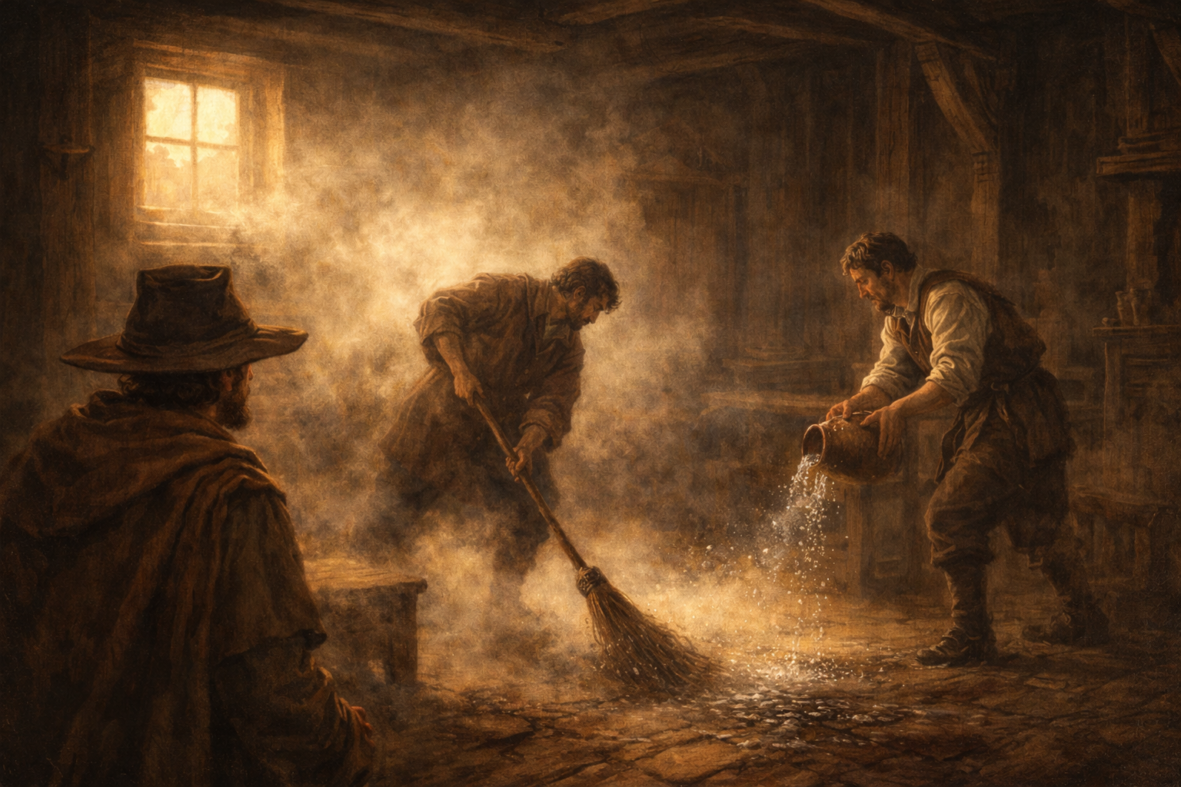
Interpreter leads Christian into a room that has not been cleaned in a very long time. Dust covers everything. The floor, the furniture, the air itself feels heavy with it. A man comes in with a broom and begins to sweep, which at first seems like exactly what should happen.
If the room is dirty, you clean it.
But the more he sweeps, the worse it becomes. The dust rises into the air until no one in the room can breathe. Instead of fixing the problem, the sweeping makes the whole place almost unlivable.
Then someone else comes in and sprinkles water on the floor. The dust settles. The air clears. Now the room can actually be cleaned.
Bunyan does not leave the meaning hidden.
The dusty room is the human heart.
The dust is sin.
The man with the broom is the law.
The choking air is what happens when the law stirs up sin but cannot remove it.
The water is the gospel.
It is such a simple scene, but anyone who has tried to take the Christian life seriously knows exactly what he is talking about. At some point, you realize that trying harder is not fixing the problem. Sometimes it even seems to make the struggle feel stronger.
When the law starts to do its work
The Bible speaks about the law in a way that surprises people. Scripture never says the law is bad. In fact, Paul goes out of his way to say the opposite.
“So then, the Law is holy, and the commandment is holy and righteous and good.” (Romans 7:12, LSB)
The law is not the problem. The problem is what the law reveals.
When God’s commands are taken seriously, they show us what holiness really looks like. And when we see what holiness really is, we start to notice how far we fall short of it. That is why Paul writes,
“For through the Law comes the knowledge of sin.” (Romans 3:20, LSB)
The law turns on the light, but turning on the light is not the same thing as cleaning the room.
Anyone who has grown in the Christian life knows this feeling. You start reading Scripture more carefully. You want to obey more faithfully. You notice attitudes you used to ignore. Words you wish you could take back. Motives that are not nearly as pure as you thought they were.
So you try harder.
You make new rules.
You promise yourself you will do better next time.
And somehow the dust just keeps rising.
Paul describes that struggle in Romans 7 with almost painful honesty. He sees the goodness of God’s law, but he also sees something in himself that resists it. He wants to do what is right, yet he keeps finding himself pulled the other way. The result is not confidence. It is frustration, and sometimes even grief.
The broom is moving, but the air is getting thick.
Why the broom is not enough
This is the lesson Christian has to learn before he can go any farther down the road. If you think the broom is enough, the journey will eventually break you.
The law was never given to save us.
It was given to show us that we need saving.
Paul says it plainly in Galatians,
“So the Law has become our tutor to lead us to Christ, so that we may be justified by faith.” (Galatians 3:24, LSB)
A tutor can point the way, but a tutor cannot finish the work.
The law shows us what God requires.
It shows us what we are.
It shows us that the distance between the two is greater than we wanted to believe.
But the law cannot change the heart that keeps raising the dust.
It can tell you what is right.
It cannot make you right.
And if all you have is the broom, you will keep sweeping the same room for the rest of your life.
When the water is sprinkled
In Bunyan’s picture, everything changes when the water comes.
Someone sprinkles the floor, the dust settles, and suddenly the room can be cleaned without choking everyone inside. The problem was never that the room should stay dirty. The problem was that the broom alone could never fix it.
This is where the gospel comes in, and this is why the gospel feels like such relief to anyone who has really felt the weight of the law.
The law says, You must be righteous.
The gospel says, Christ is righteous for you.
The law says, You have sinned.
The gospel says, Christ has paid.
The law says, You deserve judgment.
The gospel says, “There is now no condemnation for those who are in Christ Jesus.” (Romans 8:1, LSB)
Paul makes it even clearer in Galatians,
“A man is not justified by works of the Law but through faith in Christ Jesus.” (Galatians 2:16, LSB)
The gospel does not pretend the dust is not there. It deals with the dust at the root. It forgives. It cleanses. It gives a new heart, not a stronger broom.
The water settles what the sweeping could never control.
The mistakes we keep making
Bunyan’s little scene explains why so many believers get stuck in the same place for years.
Some try to live the Christian life with nothing but the broom. They believe that if they try hard enough, discipline themselves enough, pray enough, read enough, then eventually they will become the kind of person God accepts. But the more they sweep, the more dust they see, and the more discouraged they become.
Others go the opposite direction. They hear about grace and decide the dust does not matter. They stop taking sin seriously. They stop listening when the law convicts. They call freedom what the Bible calls bondage.
One life is full of pressure.
The other is full of excuses.
Neither one is the narrow road.
The law without the gospel will suffocate you.
The gospel without the law will fool you.
But together, they lead you to Christ.
Walking the Narrow Road
This is why Christian had to see the dusty room before he went any farther.
There comes a point in the Christian life when self-confidence starts to crack. You realize you cannot fix yourself. You cannot outgrow sin by determination. You cannot make yourself holy just because you want to be holy.
And that realization can feel like the room filling with dust.
You wonder why the struggle feels stronger than before.
You wonder why obedience feels harder now that you care about it.
You wonder why the closer you try to walk with God, the more aware you are of your weakness.
The law is doing its work.
But the law is not the end of the story.
The gospel reminds us that our hope was never in our performance to begin with. Our hope was always in Christ.
Have you confused conviction with condemnation?
Have you tried to earn what can only be received?
Have you avoided the law because it hurts, or avoided the gospel because it humbles?
Christian learned in that dusty room what every pilgrim must learn sooner or later.
We do not clean ourselves.
We are cleaned.
We do not save ourselves.
We are saved.
The law tells the truth about us.
The gospel tells the truth about Christ.
And the narrow road is walked by those who know both, who stop trusting their own strength, and who follow the One who settles the dust, washes the heart, and leads His people forward in grace.
Walk the narrow road.