This is part of the Walking the Narrow Road Road: A Year with The Pilgrim’s Progress
Christian had not gone far after leaving the sleepers when he noticed something that made him slow his steps.
Two men were walking ahead of him on the road.
At first, he assumed they must have come through the gate, the same way he had. Everyone on this path was supposed to begin there. The gate was narrow, and it was the only entrance Bunyan had shown so far. So when Christian saw these two men already on the road, his first thought was that he must have passed them without noticing.
But the longer he watched them, the more it bothered him.
He did not remember seeing them at the gate.
The path where he had entered was clear in his mind. He remembered the struggle, the fear, the relief of finally getting through. He remembered how narrow the opening was, how there had been no other way in.
So he walked faster until he caught up with them.
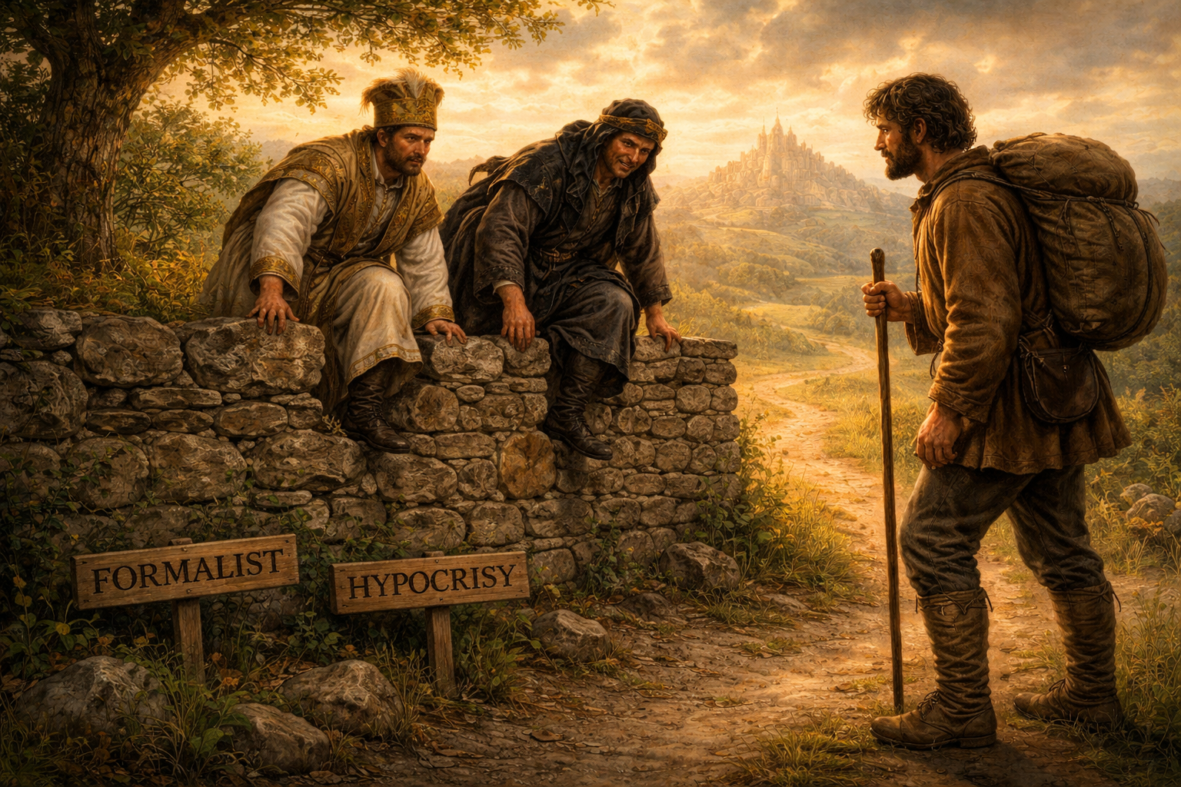
When he asked how they had come onto the road, they answered without hesitation. They said they had climbed over the wall. That was how people from their country always entered. It was easier, and everyone did it that way.
Their names, Bunyan tells us, were Formalist and Hypocrisy.
They looked like pilgrims.
They spoke like pilgrims.
They said they were going to the same city.
But they had not come through the gate.
Why the Gate Matters
The narrow gate in Bunyan’s story is not just part of the scenery. It represents the beginning of the Christian life. It is the point where a person stops trusting himself and turns to Christ. It is the place where the old life is left behind and the new life begins.
That is why there is only one entrance.
“I am the door; if anyone enters through Me, he will be saved, and will go in and out and find pasture” John 10:9.
“Enter through the narrow gate; for the gate is wide and the way is broad that leads to destruction… For the gate is small and the way is narrow that leads to life” Matthew 7:13–14.
Formalist and Hypocrisy wanted the road, but not the gate.
They wanted the journey without the beginning.
They wanted the destination without the surrender.
They wanted to belong without being changed.
So they climbed over the wall.
It looked close enough.
It felt good enough.
It seemed to work.
But it was not the way in.
Religion Without New Birth
Bunyan is pointing to something Jesus said very plainly.
“Unless one is born of water and the Spirit he cannot enter into the kingdom of God” John 3:5.
Nicodemus was a religious man. He knew the Scriptures. He kept the traditions. He lived a careful life. If anyone should have been safe, it would have been him.
But Jesus told him that religion was not enough.
He needed new birth.
Formalist trusted the form.
Hypocrisy trusted the appearance.
Neither had life.
This is one of the hardest truths for religious people to hear. A person can know the language of faith, keep the habits of faith, and still never pass through the gate.
Church attendance is not new birth.
Moral effort is not new birth.
Family tradition is not new birth.
Knowing the right answers is not new birth.
The gate cannot be climbed over.
It has to be entered.
Why This Is Hard to See
Part of what makes this danger so serious is that it does not look wrong at first.
Formalist and Hypocrisy are not running away from the road.
They are walking on it.
They are not mocking the journey.
They say they are going to the same place.
They are not denying the truth.
They talk as if they believe it.
From the outside, everything looks fine.
That is why Bunyan gives them these names. Formalist keeps the outward form. Hypocrisy keeps the outward appearance. Both look right, but neither has come the right way.
Jesus warned about this more than once.
“Not everyone who says to Me, ‘Lord, Lord,’ will enter the kingdom of heaven… Many will say to Me on that day, ‘Lord, Lord, did we not…’ And then I will declare to them, ‘I never knew you’” Matthew 7:21–23.
Those words are not spoken to strangers to religion.
They are spoken to people who thought they were already on the road.
Wanting the Road Without the Gate
Climbing over the wall is a picture of something very real.
It is the desire to have the life of a Christian without the surrender that begins the life of a Christian.
To have belonging without repentance.
To have comfort without conviction.
To have the promises without the cross.
Formalist says the outward life is enough.
Hypocrisy says the outward life is all anyone can see anyway.
But the narrow gate is not about what others see.
It is about what God makes new.
“If anyone is in Christ, he is a new creature; the old things passed away; behold, new things have come” 2 Corinthians 5:17.
New birth does not mean perfection.
It means life where there was none before.
True Conversion Changes the Heart
When Christian came through the gate, something changed. He still struggled. He still feared. He still had a burden for a time. But the direction of his life was different.
He did not climb in.
He entered.
He did not make his own way.
He came the way he was shown.
That is what regeneration does. It does not make a person flawless, but it gives him a new heart. New desires. A new direction. A new Lord.
Formalist and Hypocrisy had the road under their feet, but they did not have that.
And Bunyan wants the reader to notice the difference early, before the journey goes any farther.
Not Everyone on the Road Came Through the Gate
Christian keeps walking.
Formalist and Hypocrisy walk with him for a time. They talk the same way, they look the same, and for a while it seems as if they belong there.
But Bunyan will show later that the difference does not stay hidden forever.
Not everyone on the road entered through the gate.
Some climbed over the wall.
Some learned the language.
Some followed the crowd.
But the road to the Celestial City begins the same way for every pilgrim.
Through the narrow gate.