
Hezekiah, Crisis Leadership, and the Danger After the Win
Introduction: The Crisis Behind the Crisis
Some crises attack infrastructure. Others attack imagination.
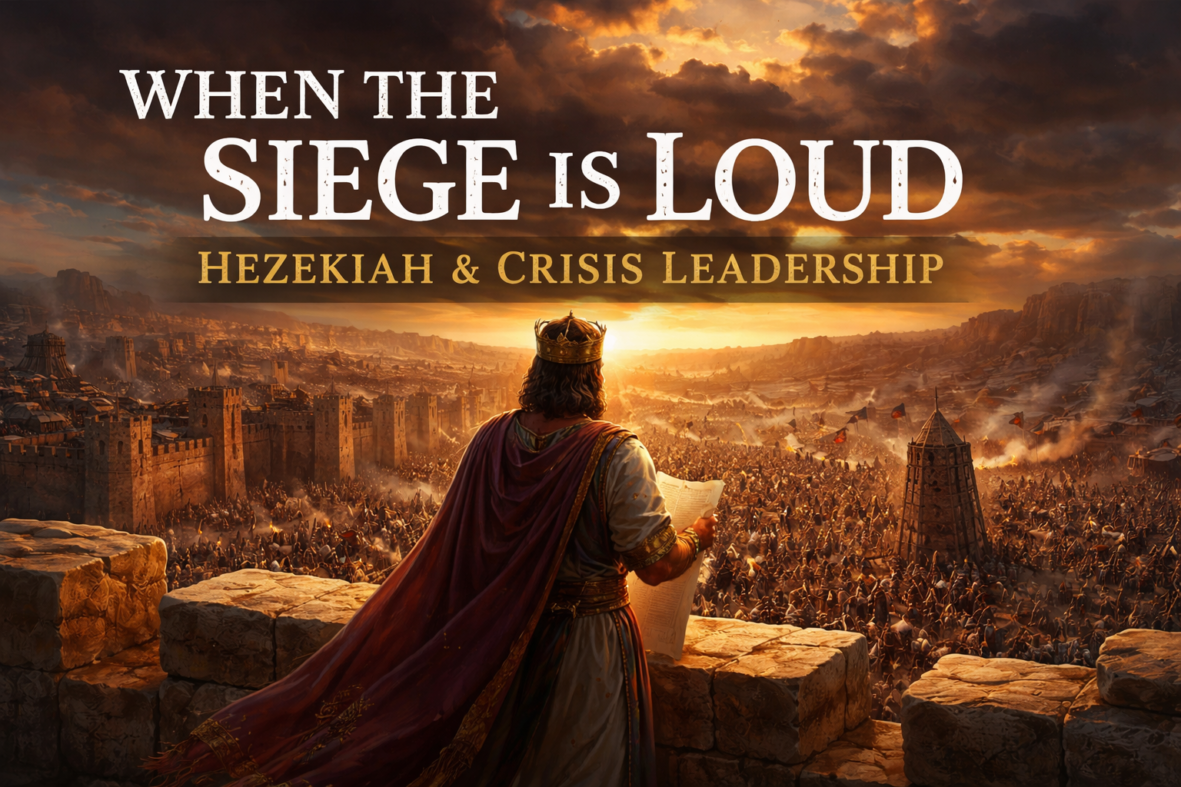
In 2 Kings 18–20, Isaiah 36–39, and 2 Chronicles 29–32, Judah faces the Assyrian empire at the height of its dominance. Sennacherib’s forces surround Jerusalem. The military threat is real. Cities have already fallen. Refugees have already fled. The psychological pressure is suffocating.
But the most dangerous weapon Assyria deploys is not a siege tower. It is a speech.
Rabshakeh stands within earshot of Jerusalem’s defenders and begins dismantling confidence in public view. He mocks Hezekiah. He questions military capability. Most critically, he reframes trust in Yahweh as delusion (2 Kings 18:28–35, LSB). He does so deliberately in Hebrew, bypassing officials and speaking directly to the people (Isa. 36:11–13).
This is information warfare. It is narrative warfare.
The crisis is not only at the wall. It is in the minds of the citizens.
That is why Hezekiah’s story is not merely historical. It is instructional. It reveals what leadership looks like under existential pressure — and what it must guard against when the pressure lifts.
Legitimacy Before the Storm
The biblical text does something important before Assyria ever appears. It establishes Hezekiah’s moral orientation.
“He did what was right in the sight of Yahweh, according to all that his father David had done” (2 Kings 18:3, LSB).
That statement is not filler. It is foundation.
Hezekiah’s reforms are substantial. He removes high places. He destroys the bronze serpent that had become an object of idolatry (2 Kings 18:4). He reopens and cleanses the temple (2 Chron. 29). He restores covenant worship and national repentance.
In other words, his leadership is values-centered before it is crisis-tested.
Modern leadership research frequently uses the language of legitimacy and ethical climate. Legitimacy is not manufactured in the moment of emergency; it is accumulated over time through consistent moral action. Ethical climates shape how followers interpret leader decisions under stress.
Scripture shows the same dynamic without the jargon. A king who has demonstrated covenant fidelity possesses moral credibility when fear rises. The people know where he stands.
Leadership capital is built before it is spent.
You cannot improvise integrity when Assyria is at the gate. Either your leadership rests on enduring commitments, or it rests on expediency. Crisis simply reveals which.
Selah.
Crisis Sensemaking: Stabilizing Meaning Before Mobilizing Action
When Rabshakeh speaks, the temptation would have been immediate public rebuttal. Leaders often feel compelled to match volume with volume. Yet the response is striking:
“But they were silent and answered him not a word; for the king’s commandment was, ‘Do not answer him’” (2 Kings 18:36, LSB).
Silence here is strategic containment.
Hezekiah refuses to allow the enemy to dictate emotional tempo. He then tears his clothes and goes into the house of Yahweh (2 Kings 19:1). He sends for Isaiah. He prays.
In contemporary leadership theory, crises are described as environments of compressed time, high uncertainty, and heightened scrutiny. Under such conditions, leaders must engage in disciplined sensemaking — interpreting events before acting decisively. Interpretation precedes intervention.
Hezekiah models this.
He spreads the letter from Assyria before Yahweh and prays:
“O Yahweh, the God of Israel… You alone are God of all the kingdoms of the earth” (2 Kings 19:15, LSB).
Notice the structure of his prayer. He does not deny the threat. He names it clearly. But he situates it within a larger theological reality: God’s sovereignty over nations.
This is not escapism. It is recalibration.
Under crisis, communities require more than operational directives. They require meaning. They need to know how to interpret what is happening.
Hezekiah stabilizes meaning before he mobilizes action. That stabilizing act protects the people from panic-driven reaction.
Walk that into our moment. When headlines are loud and commentary relentless, the first leadership task is not volume. It is clarity. Not denial — but theological framing. Not hysteria — but conviction.
Adaptive Leadership: Prayer and Preparation Together
A common false dichotomy appears in Christian leadership: trust versus preparation. The narrative refuses that divide.
2 Chronicles 32 details Hezekiah’s practical measures. He strengthens defensive walls. He builds additional fortifications. Most famously, he secures the water supply by redirecting the Gihon spring through a tunnel into the city. Archaeology confirms this remarkable engineering feat.
Hezekiah prays. Hezekiah plans.
This integration aligns closely with what contemporary leadership theory calls adaptive leadership — the capacity to adjust structures and coordinate resources under volatile conditions without abandoning core values.
Importantly, preparation is not portrayed as lack of faith. Nor is prayer portrayed as neglect of responsibility. The king does not spiritualize away vulnerability. He acts decisively within covenant constraints.
For leaders today — in churches, nonprofits, businesses, public service, or homes — this is critical. Faith does not eliminate risk management. Dependence does not remove strategic responsibility.
Preparation that abandons moral constraint becomes manipulation. Prayer that abandons responsibility becomes presumption.
Hezekiah avoids both extremes. His leadership demonstrates covenant-aligned competence — adaptive action bounded by theological clarity.
Ethical Framing: What Crisis Allows and What It Does Not
Under pressure, leaders can subtly shift frames. Survival becomes the overriding justification. Ethical lines blur under the logic of necessity.
Behavioral ethics research shows that the frame through which leaders interpret a situation significantly shapes what they perceive as permissible. When crises are framed purely as business or survival problems, moral concern narrows. When framed ethically, broader accountability remains visible.
Hezekiah’s prayer in 2 Kings 19 functions as an ethical framing act. He defines the crisis not simply as geopolitical threat but as a challenge to the glory of Yahweh among the nations. That frame establishes boundaries. It shapes the response.
He does not seek survival at any cost. He seeks deliverance consistent with covenant identity.
This is deeply relevant in our cultural moment. Leaders often justify questionable actions by appealing to urgency, competition, or institutional survival. The biblical narrative reminds us that crisis does not suspend covenant obligation.
If Christ is Lord, then moral constraints do not evaporate under pressure.
Leadership under covenant framework means action remains accountable to enduring commitments — even when expediency tempts otherwise.
Deliverance and the Subtle Shift
The Assyrian threat collapses dramatically. In one night, the angel of Yahweh strikes down 185,000 in the Assyrian camp (2 Kings 19:35). Sennacherib withdraws and is later assassinated.
From a leadership standpoint, this is decisive victory.
Yet Scripture does not end the story there. It moves forward to Hezekiah’s illness and recovery (2 Kings 20:1–11). God grants him additional years. Then Babylonian envoys arrive.
Hezekiah shows them everything — his treasures, his armory, his wealth (2 Kings 20:13).
The visible siege has ended. The quieter danger begins.
Isaiah confronts him. The very treasures displayed will one day be carried to Babylon. The seeds of future exile are quietly sown.
Modern leadership scholarship describes post-success overconfidence as a significant organizational risk. Success can distort judgment, amplify pride, and reduce vigilance. Hubris does not typically emerge under pressure; it often emerges after applause.
The biblical text captures this with sobering simplicity. After success, “God left him alone only to test him, that He might know all that was in his heart” (2 Chron. 32:31, LSB).
The loud siege tested Hezekiah’s courage.
The quiet season tested his humility.
Leaders rarely fall when visibly weak. They drift when visibly strong.
Selah.
Contemporary Application: Leading in the Age of Amplification
We live in an era of perpetual crisis narratives. Financial instability, technological disruption, cultural polarization, public health emergencies — each accompanied by constant commentary.
Like Rabshakeh, voices speak loudly and publicly, often bypassing formal channels to address the masses directly. Confidence is eroded not only by events but by interpretation of events.
Hezekiah’s leadership offers four enduring lessons.
First, build legitimacy before you need it. Ethical consistency over time generates trust under stress.
Second, stabilize meaning before escalating response. Interpretive clarity protects against panic-driven decisions.
Third, integrate prayerful dependence with adaptive preparation. Faith and competence belong together.
Fourth, guard against post-crisis drift. Relief can introduce vulnerabilities that pressure did not.
For Christian leaders, this is not merely strategy. It is discipleship. Leadership flows from theology. Our understanding of God’s sovereignty, human depravity, and covenant accountability shapes how we respond to pressure and praise.
We do not lead as autonomous architects of destiny. We lead as stewards under Christ’s lordship.
Doctrine → Devotion → Daily Walk
Let us bring this home in formation language.
Doctrine: God rules nations. Assyria was not ultimate. Babylon was not ultimate. No empire is. Sovereignty belongs to Yahweh.
Devotion: Crisis reveals where we go first. To commentary? To control? Or to the presence of God?
Daily Walk: Ask yourself honestly:
- What narratives are shaping my emotional responses right now?
- Am I preparing responsibly without abandoning moral boundaries?
- Has recent success softened my vigilance?
Hezekiah’s story invites sober self-examination. Leadership is not a moment. It is a sustained posture of covenant fidelity before, during, and after visible threat.
Conclusion: The Two Sieges
There are two sieges in every leader’s life.
The loud siege: when pressure is visible and courage is required.
And the quiet siege: when relief arrives and humility must guard the heart.
Hezekiah endured the first with remarkable faithfulness. He stumbled in the second.
Scripture records both not to diminish him, but to instruct us.
Ultimately, Hezekiah points beyond himself. The greater Son of David faced the loudest siege of all — mockery, betrayal, crucifixion — and did not waver. After resurrection victory, He did not drift into pride. He reigns with perfect wisdom and eternal vigilance.
That is our anchor.
Crisis will come. Voices will shout. Success will tempt.
The question is not whether the siege will be loud.
The question is whether our leadership rests on covenant fidelity — before the wall, at the wall, and long after the wall is quiet.
Live it out.
Share the truth.
Walk with courage.