

There is a moment every leader eventually faces, and it almost never arrives the way you expect.
It does not come with flashing lights or public scandal. There is no dramatic failure that forces your hand. Instead, it creeps in quietly, through repetition. A behavior is addressed. Improvement follows. You breathe a little easier. Maybe the hard conversation worked. Maybe growth is finally taking root.
Then the pattern returns.
You sit across the table again. You speak carefully. You mean what you say. They nod. They seem sincere. For a while, things improve.
And then, slowly, the drift resumes.
If you have ever carried responsibility for people, you know this hallway. It is long. It is quiet. And it is lined with questions that refuse to go away.
Am I being gracious?
Or am I avoiding something harder?
Am I extending patience?
Or am I postponing responsibility?
The most difficult leadership decisions are rarely about obvious evil. They are about prolonged tolerance. They are about patterns that never quite cross a catastrophic line, but never quite heal either.
And somewhere in that repetition, a deeper question begins to press on your conscience:
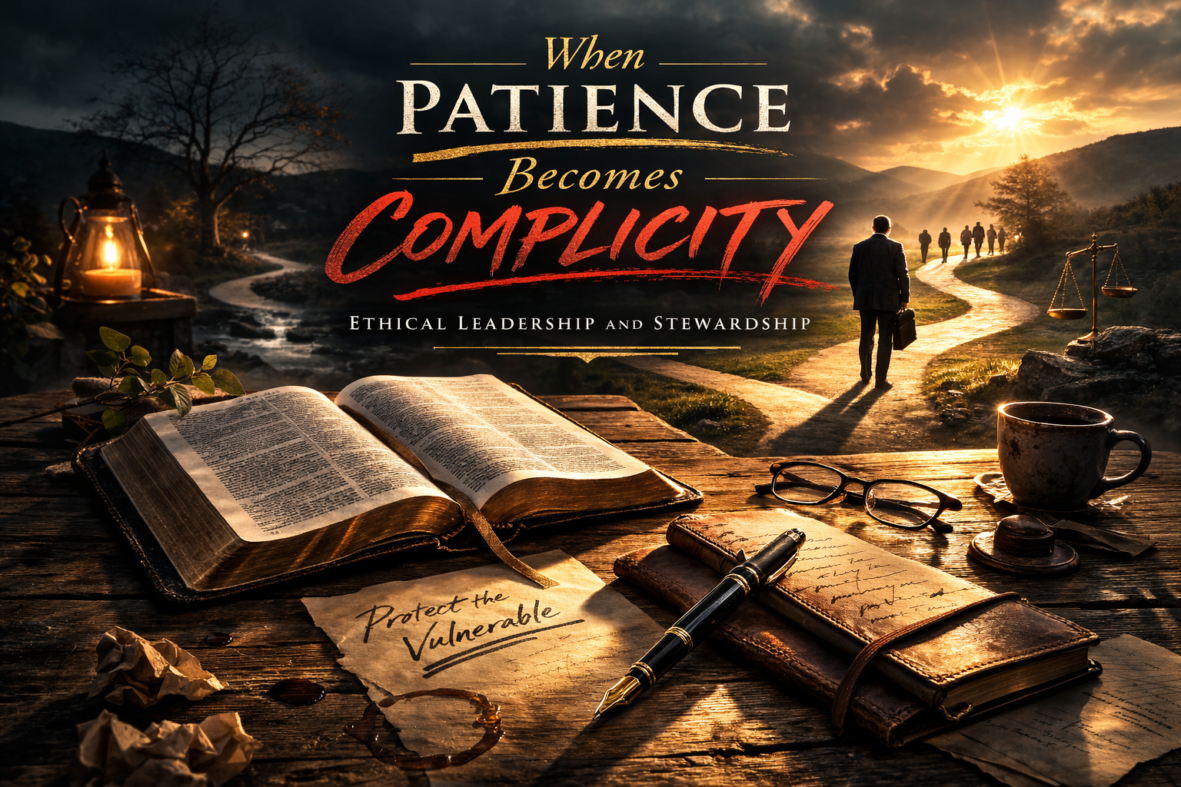
When does patience become complicity?
The Quiet Nature of Ethical Drift
Leadership failures almost never begin as moral collapse. They begin as small adjustments.
A leader steps into a wider role. The weight increases. Authority expands. Relational judgment becomes more complex. Something does not quite land the way it should. A tone is off. A pattern surfaces. A conversation becomes necessary.
Early correction often feels hopeful. Coaching produces improvement. Metrics stabilize. The situation appears manageable. You tell yourself this is what leadership is. Growth takes time. People are imperfect.
And all of that is true.
But over time, something subtle can happen. Compliance appears, yet transformation never fully settles. The behavior improves temporarily, but the deeper posture does not change. What was once concerning becomes cyclical.
Modern research has helped name this phenomenon. Scholars describe moral disengagement and ethical drift. Leaders can continue to see themselves as principled while slowly loosening the standards they once held firmly. Decisions are framed as technical instead of moral. Problems become “development issues” rather than stewardship failures.
Nothing dramatic collapses.
And that is precisely the danger.
The organization keeps functioning. Results are not disastrous. The surface looks stable. But beneath that surface, trust begins to thin. Employees adjust. Conversations become more guarded. The cost of speaking honestly grows heavier.
No one announces that integrity is slipping. It simply becomes more flexible.
Authority Is Not a Trophy
Scripture does not treat authority casually, and it certainly does not treat it as a trophy.
Romans 13 reminds us that authority is delegated. It is entrusted by God and exercised under His gaze. That reality alone should steady a leader’s heart. Authority is not something we own. It is something we steward.
Jesus sharpens this in Luke 12:48: “From everyone who has been given much, much will be required.” Authority does not insulate us from accountability. It increases it.
When you are entrusted with oversight, the charge is not merely to achieve results. It is to protect people. Scripture evaluates leadership not only by output, but by fruit that endures. Proverbs 28:13 speaks of confession and forsaking wrongdoing. Matthew 3:8 calls for fruit in keeping with repentance. Second Corinthians 7 describes repentance that produces earnestness and visible change.
In other words, Scripture does not measure growth by temporary improvement. It looks for something deeper and more durable.
And that standard does not apply only to the one being corrected. It applies to the one doing the correcting.
Biblical patience is purposeful. Romans 2:4 tells us that God’s kindness is meant to lead to repentance. Patience has a goal. It is not indefinite tolerance. Ecclesiastes 3:1 reminds us that there is a time for every matter under heaven. A time to plant. A time to uproot.
The question is not whether patience is virtuous. It is.
The question is whether your patience is still serving its purpose.
The Moment It Stops Being About One Person
Most leaders feel the turning point before they can articulate it. It is the moment when the issue is no longer primarily about the individual being coached. It becomes about the people being affected.
Employees may lack formal authority, but they do not lack dignity. Psalm 82 commands leaders to defend the weak and needy. Proverbs 22 warns against crushing those with less power.
When patterns of leadership failure persist, those under authority absorb the cost. They adjust to unpredictability. They grow cautious. They learn which concerns are worth raising and which are safer left unsaid. Not because they are disloyal, but because they are tired.
Here is the uncomfortable truth: if leadership does not act when patterns are clear, silence communicates something. It communicates that stability matters more than stewardship. That performance matters more than protection. That preserving a position matters more than protecting people.
Leaders often fear that decisive action will appear harsh. No one wants to be impulsive. No one wants to overcorrect. But prolonged restraint carries its own ethical weight. Patience that no longer produces repentance becomes permission.
What began as mercy slowly turns into accommodation.
And that is when patience begins to resemble complicity.
Framing the Question Honestly
One of the most revealing insights from leadership research is that how we frame a problem determines how we respond to it.
If a recurring issue is framed as a skill gap, we lean toward development. If it is framed as a communication problem, we pursue mediation. But when it is recognized as a stewardship failure, the moral dimension becomes unavoidable.
Not every weakness is moral. Leaders are human. We all stumble. But when authority repeatedly produces harm and accountability never quite deepens, the frame must shift.
The question changes from “How can we help this leader improve?” to “Are we faithfully protecting those entrusted to our care?”
That shift is rarely comfortable. It requires a leader to examine not only someone else’s behavior, but their own hesitation.
Mercy and Justice Belong Together
One of the quiet lies leaders believe is that mercy and justice compete.
They do not.
Micah 6:8 calls us to do justice, love mercy, and walk humbly with our God. Justice without mercy becomes severity. Mercy without justice becomes sentimentality. Hebrews 12 reminds us that discipline, though painful, yields the peaceful fruit of righteousness when rightly applied.
Patience comes first. Correction follows. Fruit is expected.
But when fruit never settles and harm continues outward, love for the vulnerable demands protection.
Removing someone from leadership is not always a failure of compassion. Sometimes it is its clearest expression. It says to those under authority, “Your dignity matters. Your work matters. Your well-being matters.”
Leadership accountability exists to serve people, not to preserve positions.
That truth lands differently when you are the one who must act. It costs something. It may cost reputation, comfort, or ease. But authority was never meant to protect our comfort. It was meant to protect those entrusted to our care.
The Courage to Step Forward
There comes a day when a leader must decide. Not out of frustration. Not out of fear. Not to make an example of someone.
But because discernment has matured.
The pattern is clear. The cost is visible. The purpose of patience has been honored. And now, faithfulness requires action.
If you are standing in that place right now, know this: God is not honored by indefinite delay when justice requires clarity. You are not protecting someone by shielding them from consequences that might finally awaken responsibility. And you are not loving your team by allowing them to quietly absorb harm.
Leadership is lonely precisely because these decisions cannot be outsourced. They must be owned.
And when they are owned with humility and sobriety, they become an act of love.
Walk It Out
Pause for a moment.
Where are you exercising patience right now? Is it producing fruit, or merely postponing discomfort? Who is absorbing the cost of your restraint? Have you framed the issue as performance when it is actually stewardship?
Authority is a gift. It is also a burden. One day, every leader will give an account not only for what they did, but for what they tolerated.
Patience is a virtue.
But when patience begins to protect dysfunction more than people, it is time to ask harder questions.
Faithful leadership is not measured by how long we wait.
It is measured by whether we protect those entrusted to our care.