

Series: The Future of the Church in a Secular Age
Scripture Focus: Revelation 7:9
If you have ever stood in an airport terminal during an international flight connection, you know what a remarkable sight it is. People from every corner of the world, every language, every shade of skin, every style of dress, all moving in the same direction with the same purpose. It is noisy, and chaotic, and strangely beautiful. For a moment, you catch a glimpse of how big the world really is.
But even that moment is small compared to the scene the Apostle John witnessed in Revelation 7. He saw something far beyond an airport terminal. He saw a gathering so vast he said it could not be counted. A multitude from every nation, all tribes and peoples and tongues, standing before the throne and before the Lamb, clothed in white, worshiping with a single voice.
It is one of the most breathtaking pictures in all of Scripture. Diversity does not disappear in the presence of God. It is celebrated. It is sanctified. It becomes part of the worship.
When you read that scene, you cannot help but sense the heartbeat of heaven. God did not design a monochrome kingdom. He designed a multi-ethnic family that reflects His creativity and His redeeming love. And if that is the future God has prepared, it raises a simple but challenging question.
If heaven looks like this, why does the Church so often look like something else?
Most churches are not hostile to diversity. They simply drift into sameness. We gravitate toward people who look like us, think like us, and speak like us. It feels easier. It feels familiar. It feels safe. But sameness, however comfortable, does not reflect the fullness of God’s redemptive vision.
Revelation 7:9 reminds us that unity is not uniformity. God is not trying to erase our distinctions. He is redeeming them. He is weaving them together into something stronger than any of us could ever be on our own.
The early Church understood this. Think of Antioch, the first truly multi-ethnic congregation in the New Testament. You had Jews and Greeks, Africans and Middle Easterners, scholars and laborers, all worshiping together, all learning together, all laboring side by side. By human standards, that should not have worked. People from such different backgrounds do not naturally form a community.
But the Holy Spirit did something only He can do. He created unity that did not depend on similarity. He produced love that crossed cultural divides. And the world noticed. In fact, Antioch became the missionary engine of the early Church, sending Paul and Barnabas out to carry the Gospel across continents.
Diversity was not an obstacle to mission. It became the fuel.
Today, the words unity and diversity are thrown around a lot. Entire institutions make slogans out of them. Yet the biblical vision is far richer and far more demanding than anything our culture imagines. The world often uses diversity as a political tool. Scripture uses it as a doxological one. According to Revelation 7, diversity is about worship, not ideology. It flows from grace, not guilt. It is rooted in redemption, not resentment.
And because of that, the unity we pursue as Christians is different too. The world tries to unite people by minimizing differences or by rallying them around shared preferences. Biblical unity does something far deeper. It takes people who would never naturally be one and binds them together through Christ.
Unity is not the absence of differences. It is the presence of Christ in the midst of them.
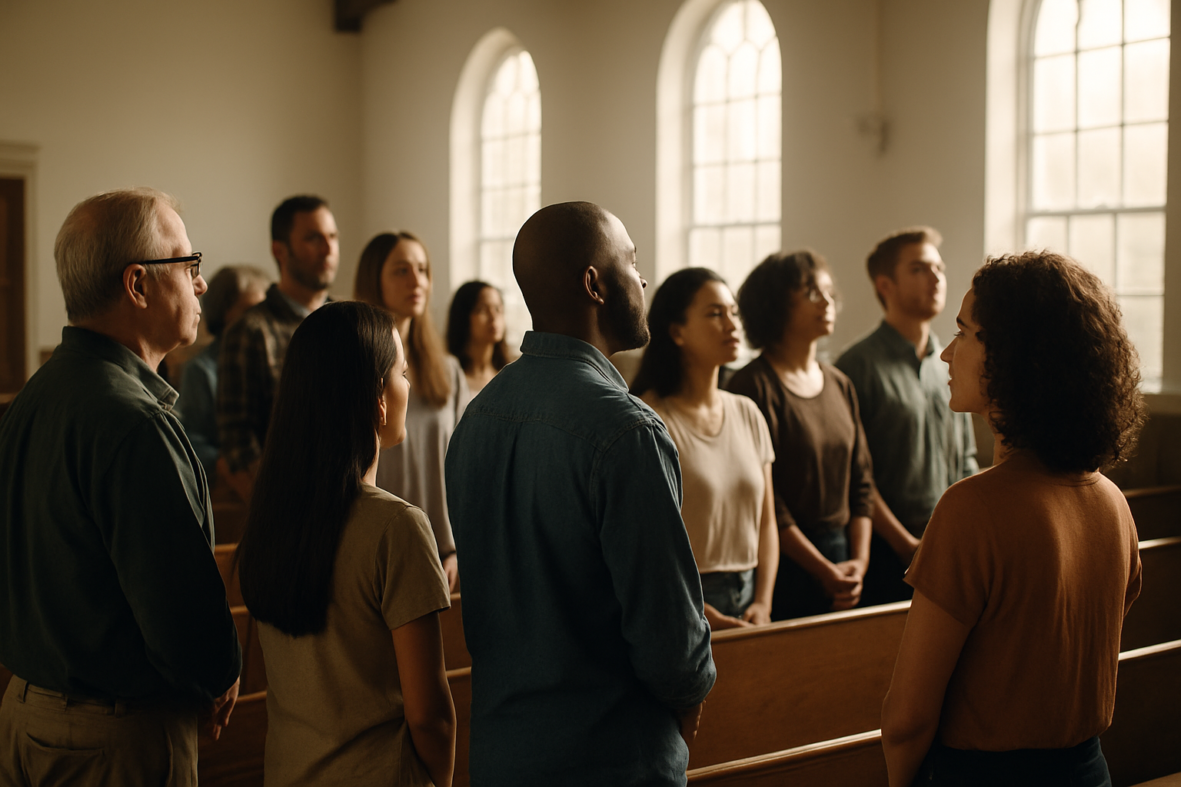
That truth makes the local church one of the most beautiful apologetics in the world. When people walk into a congregation and see believers from different backgrounds loving each other, serving each other, and worshiping together, they encounter something they cannot explain with natural reasoning. It is evidence that the Gospel is not just true. It is powerful.
But let us be honest. Building this kind of unity takes work. Real work. You cannot microwave a multi-ethnic church. You cannot manufacture trust overnight. You cannot leap across cultural gaps without patience and humility. And, if we are being completely honest, you cannot expect every potluck dish to agree with your taste buds.
This work requires listening more than talking. It requires being slow to judge and quick to understand. It requires admitting that your experience of the world is not the only one in the room. It requires hospitality that stretches beyond familiar circles and friendships that are willing to be shaped rather than curated.
It also requires courage. Bridging differences is sacred work, and sacred work is often spiritual warfare. The enemy loves division. He loves suspicion. He loves the lies we tell ourselves about others. That is why Paul told the Ephesians to be eager to maintain the unity of the Spirit. Unity is a gift God gives, but maintaining it is a responsibility God commands.
And here is where humor does its small but faithful part. Anyone who has ever served in church ministry knows that diversity is not just about race or nationality. It is also about personality. Every church has the talkers and the quiet ones, the huggers and the hand-shakers, the theologians and the people who only show up for the chili cook-off. It is messy. It is unpredictable. And it is exactly where the grace of God shows up.
The beauty of a multi-ethnic, multi-generational, multi-gifted church is that it forces us to depend on the Spirit rather than our own preferences. It reminds us that Christianity is not a consumer product. It is a community being shaped into the likeness of Christ.
And that transformation does not happen in isolation. It happens when believers learn to love one another across differences. When they humbly confess, forgive, bear with, and celebrate one another. When they choose to see each other not through the lens of culture but through the lens of Christ.
The Gospel gives us everything we need for this kind of unity.
It gives us forgiveness when old wounds surface.
It gives us patience when misunderstandings arise.
It gives us humility when our perspective needs correction.
It gives us joy when reconciliation breaks through.
It gives us hope when the work feels slow.
Revelation 7:9 does not show us something impossible. It shows us something inevitable. God will finish this story beautifully. One day, we will stand shoulder to shoulder with brothers and sisters from all over the earth, all praising the Lamb with one voice. There will be no rivalry. No resentment. No suspicion. Only worship.
The question for us is not whether a multi-ethnic church is God’s will. Scripture has already made that clear. The question is whether we will practice today what we will celebrate for eternity.
So here is a simple place to begin. Ask the Lord to make your heart spacious enough to hold someone different from you. Invite someone into your life who does not share your background or assumptions. Listen to their story. Invite their voice. Share your table. Pray together. Serve together. Let Christ stitch your hearts together in ways that make the world stop and wonder.
When the Church embraces this kind of unity, she becomes a preview of heaven. A community where the divisions of earth lose their power. A place where the beauty of redemption glows through a mosaic of people God has gathered in love.
And in a fractured age, that kind of unity is a lighthouse. It shines across the waters of division and tells the watching world that reconciliation is not a myth. It is a miracle. And that miracle has a name. His name is Jesus.
Live it out. Share the truth. Walk with courage.