A personal reflection on September 11, my father, and the stories we owe the next generation.
Twenty-five years ago today, the world changed.
That sentence gets used so often that it can become a cliché, but there are certain days when it is simply true. Every generation seems to have a handful of moments that become fixed points in memory. For one generation, it was Pearl Harbor. For another, the assassination of John F. Kennedy. I remember the fall of the Berlin Wall. There are moments like that, moments when history stops being something happening somewhere else and suddenly walks into your own life. Years later, someone mentions the event and you do not need a history book to tell you where you were. You know.
September 11, 2001, is one of those days.
If you were old enough to remember it, chances are you can still picture the room, the television, the people around you, perhaps even the first person you talked to. You remember the first confused reports and the moment you realized that whatever was happening was much bigger than anyone first understood.
I know exactly where I was.
I was at Walt Disney World.
Melody and I had arrived on Sunday, September 9, with our son Connor. He was twelve days shy of his second birthday, and Delaney had not been born yet. At the time, we were Disney Vacation Club members, and September was one of our favorite times to visit. The summer crowds had thinned, school was back in session, and we were staying for the first time at the Villas at Disney’s Wilderness Lodge. We had a long vacation planned. We would spend the first part of the trip at Walt Disney World and then head down to Disney’s Vero Beach Resort before flying home on September 21.
Tuesday morning was supposed to be simple: breakfast at Whispering Canyon Café and then a morning at the Magic Kingdom.
I remember that breakfast almost absurdly well. We had finished eating and were waiting for our check. And waiting. I was getting impatient. The Magic Kingdom was sitting right outside, we had a toddler, and in the peculiar logic of a Disney vacation, every extra minute sitting at a restaurant table felt like lost park time.
Eventually our waitress came over and apologized. There was a reason things were taking so long, she explained. People in the back were watching television because a plane had crashed into the World Trade Center.
That was how September 11 entered my life.
A waitress told me.
There was no emergency alert vibrating in my pocket. No Facebook. No Twitter. No endless feed of live video and instant analysis. In 2001, news still arrived in pieces. Somebody saw something on television. Somebody heard something on the radio. Somebody called someone else. And in those first minutes, none of us really understood what she had just told us. A plane had hit the World Trade Center. Was it an accident? A small plane? Some horrible navigational mistake? The country was confused because the information itself was confused.
So I did what came naturally.
I called Dad.
My dad had been an FBI special agent, so there was a practical reason I wanted his take. He also had his old network of FBI guys—his “G-boys,” as we called them. Long before Facebook groups and group chats made it normal for everybody to carry a network around in their pocket, those former agents had their own informal web of relationships. Somebody knew somebody who had heard something from somebody still close to the action. On a morning when reliable information was scarce and rumors were multiplying, Dad was plugged into people whose instincts I trusted.
But that only explains part of why I called him. The simpler truth is that I called my dad about nearly everything.
When something happened in the world, I called Dad. When something happened at work, I called Dad. When something happened in my life, I called Dad. Sometimes I wanted advice. Sometimes I wanted his opinion. Sometimes I simply wanted to tell him a story. Talking to him was part of the rhythm of my life, so on the morning the world seemed to be coming apart, of course I called my dad.
We paid the bill, gathered up Connor, and headed for the boat that would take us from Wilderness Lodge to the Magic Kingdom. I kept talking with Dad as we went. Some of the exact sequence has faded after twenty-five years. I cannot tell you precisely where we were when we learned the second plane had struck the South Tower. I do not remember whether we knew before we boarded the boat, while we crossed the water, or after we arrived at the park.
Memory does that. It does not preserve a day like a security camera. It holds onto pieces: a voice, a room, a look on someone’s face, a feeling. Sometimes the smallest detail survives while a much larger one fades.
I remember Dad’s voice. I remember the boat. And I remember that with every new piece of information, the morning felt a little less normal.
Still, we went to the Magic Kingdom. Looking back, that can sound strange, but what else were we supposed to do? We were a young family on vacation with an almost two-year-old. We had begun that morning planning breakfast followed by Fantasyland, and the full weight of what was happening had not yet reached us.
We walked into the Magic Kingdom without a security checkpoint. No table where somebody asked you to open your bag. No one looking through backpacks. We simply entered the park. That was normal then, and we gave it no thought at all.
We had no idea we were doing it for the last time.
We walked up Main Street U.S.A. and headed toward Fantasyland. Our first ride was going to be Snow White’s Scary Adventures. By the time we reached Fantasyland, though, Melody and I began noticing something strange. Cast Members were standing where Cast Members normally did not stand.
That may not sound significant unless you had spent a lot of time at Disney. Disney is choreography. The show works because people are where they are supposed to be, doing what they are supposed to be doing. Different lands have their own rhythms, costumes, and Cast Members. You absorb that order without consciously studying it.
That morning, the order was off.
There were Cast Members from different areas gathered together. They were talking quietly, watching and waiting. We noticed it immediately. Something was wrong. But Snow White was there, Connor was with us, and we still did not understand the scale of what was happening.
So we rode Snow White.
I have thought about those few minutes many times over the last twenty-five years. We climbed into the ride vehicle with Connor and disappeared into the darkness. Snow White. The dwarfs. The witch. A mom and dad with their little boy doing something families had done at Walt Disney World thousands of times before.
Then the ride ended. We came through the exit and stepped back into Fantasyland.
It was empty.
That is the image that has never left me. Fantasyland should not be empty in the middle of the morning. Fantasyland is noise and motion. It is strollers, children, music, parents trying to figure out where Peter Pan is, families moving in every direction at once.
But the people were gone.
Cast Members told us to head toward the exits. The Magic Kingdom was closing. We were being evacuated.
I do not remember panic. In fact, what I remember is how calm and organized it felt. Disney was doing what Disney does: directing people, maintaining order, trying not to create fear. But underneath that calm was tension. You knew the Cast Members directing you toward the exits knew more than you did. Walt Disney World does not simply close in the middle of a beautiful Tuesday morning.
When we had walked into Snow White, we were still trying to have an ordinary day.
When we walked out, Fantasyland was empty.
History had caught up with us.
I got back on the phone with Dad, and the news kept getting worse. A second airplane had hit the World Trade Center. A plane had struck the Pentagon. Another had gone down in Pennsylvania. Again, I cannot tell you exactly which report reached us at which moment, and I do not want to pretend I remember with a precision I simply do not have. What I remember is the accumulation. One thing, then another, then another, until there was no possible way to call any of it an accident.
America was under attack.
Dad was talking to his network. I was talking to Dad. None of us had the complete picture because nobody had the complete picture. That is one of the hardest things to explain now. Twenty-five years later, September 11 comes with a timeline. We know the flight numbers, the names, the hijackers, the organizations responsible, the wars that followed. We have documentaries, commissions, books, memorials, photographs, and hours of footage.
That morning we had none of that.
We did not know whether more planes had been hijacked. We did not know whether other cities would be attacked. We did not know whether there were people on the ground preparing something else. We did not know whether what we were seeing was ending or only beginning.
We were living inside the question mark.
Eventually we made it back to Wilderness Lodge, and like everyone else in America, we turned on the television. We watched smoke pouring from the towers. We watched people running through Manhattan. We watched firefighters moving toward buildings while everyone else was trying desperately to get away from them. We watched the Pentagon burn. We watched airplanes disappear into steel again and again on replay. And then we watched the towers come down.
There we were at Walt Disney World, a place built around escape and imagination, watching one of the darkest mornings in American history unfold from our villa. There is no elegant way to reconcile those two realities. They simply occupied the same room.
Then, somewhere in the middle of all of it, we had to figure out dinner.
It sounds almost stupid when I say it now. America had been attacked. Thousands of people were dead or missing. Lower Manhattan was covered in smoke and dust. Nobody knew what was coming next. And we had a toddler who needed to eat, while our dinner reservation was sitting inside a park that was now closed.
But that is how real life works. History can be enormous while the human beings living inside it still have very ordinary needs.
Years later, after serving in disaster response myself—including as an Incident Commander and chaplain during Hurricane Harvey—I came to understand that much better. From a distance, disasters are measured in rainfall, wind speed, flooded homes, casualties, logistics, command structures, and maps. On the ground, people ask smaller questions. Where is my mother? Is my house still standing? Can I charge my phone? Does anybody have my medication? Where are we going to sleep tonight?
On September 11, our question was simply: Where do we feed Connor?
I remember going down to the quick-service area at Wilderness Lodge that afternoon, and something had changed among the guests. People were talking to each other—not polite vacation small talk, but really talking. One man told us he had been playing golf when Disney came and pulled them off the course. Somebody else had been somewhere else when they heard. Everyone seemed to be comparing fragments of information and telling one another where they had been when their ordinary Tuesday stopped being ordinary.
Everyone had a story.
That night we were able to eat at ’Ohana at the Polynesian. The parks were closed, but the resorts were still open, caring for thousands of guests whose carefully planned vacations suddenly did not matter very much.
I remember the mood in that restaurant much more than I remember what we ate. People were stunned. People were frightened. People were angry.
And I remember Connor.
He was almost two years old. He did not know what the World Trade Center was. He did not understand terrorism or hijacked airplanes or the Pentagon. He had no idea why the adults around him were talking differently or why televisions suddenly seemed so important.
There was music.
So Connor danced.
I can still see him.
Our little boy danced around ’Ohana while the adults around him tried to understand what had happened to the world. There was something almost jarring in the innocence of it. He did not know.
We did.
And we did not yet know what to do with what we knew.
There was fear in the restaurant, but there was anger too. We had been attacked.
I use that word intentionally: we.
Something happened during September 11. The pronoun changed. It was not simply that New York had been attacked. We had been attacked. Those firefighters were not merely New York’s firefighters anymore. They were ours. Those police officers were ours. The passengers aboard those airplanes were ours. The families holding pictures of missing husbands, wives, sons, and daughters were ours.
For a while, millions of American “I’s” seemed to remember how to say “we.”
I do not want to polish those days into something they were not. Fear brought ugliness too. Innocent people were treated shamefully because of their ethnicity or religion. America did not suddenly become righteous because terrorists attacked us. Sin did not take September 12 off.
But something good happened too, and twenty-five years of cynicism should not erase it. Flags appeared everywhere. “God Bless America” appeared on signs. Churches filled. People lined up to give blood. Firefighters and police officers became heroes far beyond New York. Strangers spoke to strangers. People checked on neighbors. For a little while, the things that divided us seemed smaller than what held us together.
Then came September 12.
Disney reopened the parks the next morning, and when we returned, something stood between us and the entrance that had not been there the morning before: security.
On September 11, we had walked into the Magic Kingdom without a bag check.
On September 12, there were checkpoints.
That may be the simplest way I know to explain how quickly the world changed. One morning there was no security checkpoint. The next morning there was. We had crossed a line without knowing on Tuesday morning that we were standing at the edge of it.


As the week continued, Walt Disney World became increasingly strange. Commercial aviation had been grounded, so no new tourists were arriving in Orlando by air while people who could leave were leaving. The parks grew quieter. I remember eating a character breakfast at the Garden Grill in EPCOT later that week, and as I remember it there was essentially our family and one other family in the restaurant.
Connor spent what seemed like twenty minutes coloring with one of the characters.
Twenty minutes with a Disney character.
Under ordinary circumstances that would have been almost impossible. For Connor, it was wonderful. For us, it was eerie.
That entire week felt like that. The rides still operated. Music still played. Characters still smiled and hugged children. But televisions showed smoke and rubble. Airports had gone silent. Security had appeared overnight. Flags were everywhere.
And through much of it, I kept talking to Dad.
He was talking with his G-boys. I was talking with him. We talked about what he was hearing, what I was seeing, what we thought it meant, and what might happen next. I cannot remember every conversation. Most of the words themselves have disappeared.
What I remember is that he was there.
I could pick up the phone and call him.
Dad went to be with the Lord in July 2019.
July carries its own memories, of course. Dates associated with loss have a way of arriving whether we invite them or not. They bring back hospital rooms, last conversations, things said and things we wish we had said.
But I have discovered something about grief that I never expected.
September 11 makes me miss my dad.
Sometimes, I think, almost more than July does.
When I return to that Tuesday morning in my mind, Dad is woven through it. I leave Whispering Canyon and call Dad. I walk toward the boat and talk to Dad. New information comes and I call Dad. The park closes and I call Dad. The news gets worse and I call Dad.
I had somebody on the other end of the phone who knew me, knew the world I came from, and would simply talk with me.
I did not understand then what a gift that was.
When you are younger, you tend to think the gift is the advice. As you get older, you realize the gift was that they answered.
I miss that.
I miss picking up the phone because something happened and knowing exactly who I wanted to call. I miss his voice. I miss Dad.
Grief is strange. It hides inside other memories. Sometimes it waits in a song, a smell, a road, a restaurant. Sometimes it waits inside a date on the calendar that belongs to the whole country but somehow contains one little private room that belongs only to you.
September 11 belongs to American history.
But part of September 11 belongs to me and my dad.
I believe he is with the Lord. That matters deeply to me. Christian hope does not require me to pretend that absence does not hurt. Paul did not tell believers that we do not grieve. He told us that we do not grieve as those who have no hope.
I have hope.
And I miss my dad.
Both are true.
Our vacation eventually continued down to Vero Beach. We were fortunate in ways we could never have anticipated when we planned the trip. We already had a rental car, and our vacation lasted long enough that by the time we were due to return home on September 21, commercial aviation had resumed.
I remember the Orlando airport when we finally flew home. Rental cars seemed to be everywhere, reminders of travelers who had driven across the country when the airplanes stopped flying. Security was everywhere too. It was physically the same airport, but it did not feel like the same place.
Nothing quite did.
Then twenty-five years passed.
The little boy dancing at ’Ohana grew up. Connor was physically there on September 11, but he was too young to remember it. Delaney was not yet born. Everything she knows about September 11 comes from history and from the stories people who were there have told her.
Dad is gone.
And somehow, on this 25th anniversary, two universities I could never have imagined becoming part of my life brought all of these memories back.
I recently graduated from the Bush School of Government and Public Service at Texas A&M University with my Executive Master of Public Service and Administration, concentrating in nonprofit management. The dean of the Bush School is John Sherman, another Texas A&M graduate and an accomplished public servant.
I first heard Dean Sherman tell his September 11 story at our Salvation Army Doing the Most Good Luncheon here in Bryan-College Station. He has also told the story in an interview with KAMU.
Sherman spent his September 11 in the White House Situation Room.
Mine happened in Fantasyland.
While Melody and I were trying to understand why the Magic Kingdom was being evacuated and how we were going to feed our little boy, Sherman was helping maintain communications at the center of the American government while nobody knew whether the White House itself might become a target.
That is an extraordinary story.
Then today another part of my life crossed paths with September 11. I am currently pursuing a Doctor of Strategic Leadership at Liberty University, and I try to watch Liberty’s Convocation online whenever I can. On the 25th anniversary, Liberty held a special Convocation featuring Lt. Gen. Richard E. “Tex” Brown III.
Brown had already lived more history by 2001 than most of us ever will. He had flown combat missions in Southeast Asia, commanded at multiple levels, and risen into senior Air Force leadership. As he spoke, he talked about those days that become markers in the life of a generation—Pearl Harbor, the Kennedy assassination, the fall of the Berlin Wall, September 11.
The days when people ask, “Where were you?”
Brown told his story.
Sherman told his.
And their stories brought mine back.
Not because mine is equal in consequence. It is not. One man was in the White House. The other was serving at the highest levels of the United States Air Force. I was riding Snow White with a toddler.
But maybe that is part of the point.
Most people experience history from ordinary places. They are standing in classrooms, driving trucks, sitting behind desks, pouring coffee, working cash registers, dropping children off at school, eating breakfast, or standing in line at Walt Disney World.
A few enormous stories sit at the center of history.
Millions of ordinary stories surround them.
That is how we remember.
The firefighters have their stories. The people in the Pentagon have theirs. The passengers aboard Flight 93 had theirs. Teachers who wheeled televisions into classrooms have theirs. The man pulled off a Disney golf course had his. The waitress who took too long to bring my check because people were watching television in the back had hers.
Melody has hers.
I have mine.
Dad had his.
Connor was there but cannot remember his.
Delaney inherited ours.
Eventually, that is what happens to memory.
It becomes testimony.
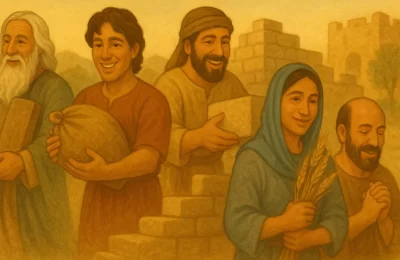
There is a story in Joshua that means more to me today than it did when I was younger. Israel crossed the Jordan River, and the Lord instructed Joshua to have twelve stones taken from the river and set up as a memorial. The stones were there because God knew something about people: eyewitnesses eventually die, children are born, and sooner or later someone who was not there asks a question.
“What do these stones mean to you?”
I love the wording of that question. Not merely, “What happened here?” What does this mean to you?
The generation that crossed the Jordan did not need someone to convince them it had happened. Their own feet had touched the riverbed. They had seen what God had done. Their children had not. Their grandchildren would not. Eventually nobody would remain who had personally crossed.
The stones would still be there.
Someone would have to tell the story.
That is biblical remembrance. It is not nostalgia. It is stewardship.
For twenty-five years we have said, “Never Forget.”
I still believe that.
But I hear those words differently today.
Connor was there and cannot remember. Delaney was not there at all. Most traditional college students hearing Tex Brown tell his story today were not alive when the towers fell. They cannot “never forget” something they never personally knew.
The responsibility has shifted.
Those of us who remember have to tell.
And I think we need to tell them about September 12 too.
John Sherman has talked about a phrase that stayed with people in the intelligence community after the attacks: “Every day is September 12.”
I cannot get that thought out of my head.
September 11 was the day America was attacked. September 12 was the morning we got up.
I remember the security checkpoint that had not existed the day before. But I remember other things too. I remember flags. I remember prayer. I remember people thanking first responders. I remember strangers talking to one another. I remember a country that, however imperfectly and however briefly, seemed to understand that “we” was a more important word than “I.”
I miss that.
I wish tragedy had not been required to produce it, and I pray another tragedy is not required to teach it to us again.
As a Christian, I also want to be careful not to turn national memory into national worship. America is not the kingdom of God, and no flag belongs where Christ alone reigns. Nations rise and fall. Political movements come and go. Our ultimate citizenship is in heaven.
But refusing idolatry does not require refusing gratitude. Courage is still courage. Sacrifice is still sacrifice. Loving your neighbor is still loving your neighbor.
On September 11, ordinary people did extraordinary things for people whose names they did not know. Firefighters climbed stairs. Police officers moved toward danger. Passengers aboard Flight 93 acted when they understood what was happening. Public servants remained at their posts. Military personnel prepared for what might come next. Churches opened their doors. People donated blood. Neighbors checked on neighbors.
And somewhere in a restaurant at the Polynesian, a little boy danced.
Twenty-five years later, that may be one of the pictures I cherish most.
Connor did not know.
Perhaps that is one reason adults stand their posts. There are always children dancing who do not yet know what the adults know. We protect what we can for them. We tell the truth about evil. We try to preserve what is good. And when they become old enough to ask what happened, we tell them.
Twenty-five years later, I remember waiting impatiently for a restaurant check. I remember the waitress telling us that a plane had hit the World Trade Center. I remember the boat, Main Street, the Cast Members standing where they normally would not have been, and walking out of Snow White into an empty Fantasyland. I remember Connor dancing at ’Ohana and the security checkpoint that appeared the next morning where none had existed before.
I remember the flags. I remember the prayers. I remember the word “we.”
But woven through all of it, I hear my dad’s voice.
Perhaps that is the part I did not fully understand until this anniversary. When we are younger, we think memories are about events. As we grow older, we realize they were always about people.
September 11 is part of the history of my country. But it was also a Tuesday when I called my dad over and over again, and he answered.
I cannot make that phone call anymore.
So I tell the story.
Maybe that is what memory eventually asks of us. We carry what we saw, what we felt, and who was there with us, then hand it to the people who come after us.
Connor was there but cannot remember. Delaney was not there at all. Someday their children may ask what those stones mean.
I want them to know.
So if you remember September 11, tell your story. It does not have to come from the White House, the Pentagon, or Ground Zero. Most of ours do not. Tell where you were. Tell what the day felt like before we understood. Tell about the people who ran toward danger, the flags, the prayers, the strangers who suddenly did not feel so strange.
Tell them about September 11.
And tell them what September 12 felt like.
Most of all, tell them about the people who were there with you, because one day those voices may be the part of the story you miss most.
The stones are still standing.
It is our turn to tell them what they mean.