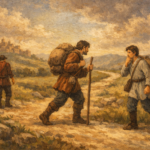



Learning to Trust God’s Direction After Awakening
This is part of the Walking the Narrow Road Road: A Year with The Pilgrim’s Progress
When Awakening Isn’t Enough
Awakening answers one question and immediately raises another.
Once Christian leaves the City of Destruction, the danger behind him is clear. Staying was no longer an option. But the road ahead is not yet obvious. Fear has pushed him into motion, but fear cannot tell him where to go.
This is where many awakened souls stall.
Conviction clarifies what is wrong, but it does not automatically reveal what is right. The burden makes movement urgent, but urgency without direction only multiplies confusion. A person can know they must leave and still not know how to walk.
Christian is no longer asleep, but he is not yet steady.
The noise around him has not quieted. Voices still call out. Some urge him back toward what feels familiar. Others offer shortcuts, reassurances, or competing paths. In moments like this, clarity is fragile. Fear can just as easily drive someone into despair as into obedience.
God does not ignore this vulnerability.
Bunyan places Evangelist here on purpose, not after the journey is established, but at the moment when confusion threatens to undo obedience. Evangelist does not appear to calm Christian’s emotions. He appears to give him direction.
This matters.
God does not awaken people simply to leave them disoriented. He does not expose danger and then demand that trembling souls chart their own way forward. When conviction has done its work, guidance follows.
Awakening wakes the soul.
Guidance steadies it.
The narrow road does not begin when everything makes sense. It begins when the right voice is trusted amid the noise and the next faithful step is taken, even while the burden still presses heavily on the back.
Christian has left the City of Destruction.
Now he must learn how to listen.
Who Evangelist Is and What He Represents
Evangelist enters the story quietly.
There is no spectacle. No dramatic interruption. No attempt to overwhelm Christian’s fear with reassurance. Bunyan does not even describe Evangelist’s appearance in detail. What matters is not who he is outwardly, but what he does.
He points.
Evangelist is not a savior. He does not remove the burden. He does not walk the road for Christian. He does not even stay long. His role is precise and limited, and that restraint is intentional.
Evangelist represents God’s appointed means of guidance: truth spoken from outside the self, grounded in God’s Word, offered at the moment it is most needed. He is the voice that clarifies direction after awakening has done its disruptive work.
This distinction matters. The Book awakened Christian. Evangelist interprets that awakening rightly.
Bunyan is careful here. He shows us that conviction alone is not enough. An awakened soul, left without direction, is vulnerable. Fear can turn inward. Guilt can harden into despair. Urgency can become recklessness. Evangelist prevents that by giving Christian a fixed point beyond himself.
“Do you see yonder shining light?”
It is a simple question, but it carries weight. Evangelist does not ask Christian how he feels. He does not ask what he prefers. He does not ask what seems reasonable. He directs Christian’s attention outward, toward something objective, something placed before him by God.
This is how biblical guidance works.
God does not invite His people to invent their own paths. He reveals a way and calls them to walk in it. He sends voices, not to replace Scripture, but to apply it faithfully. Evangelist does not add to what the Book has said. He points Christian toward its promise.
And then he gives a command.
“Keep that light in your eye, and go up directly thereto.”
There is no explanation of what lies between here and there. No warning of obstacles. No assurance of ease. Only direction, followed by a call to obedience.
This is often how God guides His people.
He makes the next step clear, not the entire journey. He gives enough light to walk, not enough to see the end. Faith, at this stage, is not confidence in outcomes. It is trust in direction.
Evangelist does not linger because lingering is not what Christian needs. The awakened soul does not require endless conversation. It requires a faithful voice that points clearly and then releases the listener to obey.
So Christian begins to move again.
Not because the burden has lifted.
Not because the road feels safe.
But because the voice he has heard rings true, and standing still is no longer an option.
Direction has been given.
Now obedience must follow.
Learning to Trust God’s Voice
Direction does not remove the need for trust. It sharpens it.
Christian now faces a quieter but no less demanding challenge. He must decide whether the voice he has heard will govern his steps when other voices continue to speak. Evangelist has pointed the way, but the noise has not disappeared. The city still calls. Fear still presses. Uncertainty still lingers.
Guidance clarifies the path, but it does not eliminate competing influences.
This is where obedience becomes personal.
To follow Evangelist’s direction, Christian must trust that God’s voice carries more authority than his fear, his confusion, or the opinions of those around him. He must believe that the light before him is sufficient, even if it does not reveal the entire road.
This is not easy. Trusting direction often feels riskier than remaining still. Standing still feels safer because it postpones decision. Moving forward commits the soul to a path it cannot yet control.
Modern readers know this tension well. We live amid constant counsel. Advice streams endlessly from experts, influencers, algorithms, friends, and our own restless thoughts. Many of these voices sound reasonable. Some sound compassionate. A few even quote Scripture. But not every voice that speaks confidently speaks with authority.
Evangelist’s guidance cuts through this confusion by its simplicity. He does not overwhelm Christian with options. He narrows them. He does not amplify Christian’s feelings. He redirects Christian’s attention. He does not ask for analysis. He calls for obedience.
This is often how God’s voice feels when it finally breaks through the noise. It is not loud, but it is clear. It does not multiply possibilities, but reduces them. It does not soothe every fear, but steadies the next step.
Selah
Whose voice do you trust when you are spiritually unsettled?
Which words shape your obedience when clarity is partial and pressure is high?
Christian cannot answer every question yet. But he can answer this one. He can decide which voice will govern his movement.
Trust, at this stage of the journey, does not mean certainty. It means submission. It means choosing to walk toward the light that has been shown, even while the burden still presses heavily on the back.
The narrow road advances not through confidence, but through trust in the right voice.
And that trust must now be lived out in obedience.
How God Guides His People
Bunyan’s portrayal of Evangelist reflects a consistent biblical pattern.
God awakens His people through His Word, and He guides them by that same Word, applied faithfully through voices He appoints. Guidance in Scripture is never detached from truth, and it is never grounded in personal intuition alone. Before the Spirit leads inwardly, God speaks outwardly.
This is why Evangelist’s authority matters. He does not invent direction. He delivers it. His guidance does not arise from Christian’s feelings or preferences. It flows from what God has already revealed.
Scripture describes this pattern repeatedly. God promises a voice behind His people saying, “This is the way, walk in it.” Jesus describes His sheep as those who recognize His voice and follow. Paul reminds Timothy that Scripture equips the servant of God for every good work. In each case, guidance is anchored in truth before it becomes a matter of experience.
This protects the believer from confusion.
If guidance were primarily internal, the loudest emotion would rule. If direction depended on certainty, obedience would always be delayed. But God gives direction that can be trusted before it is fully understood. He offers enough light to walk, not enough to control the road.
This is why obedience precedes explanation.
Evangelist’s instruction is brief because Scripture itself is sufficient. It reveals God’s will clearly enough to guide faithful steps even when circumstances remain unclear. Christian is not asked to feel confident. He is asked to be faithful.
This doctrinal clarity steadies the soul. It reminds us that God’s guidance is not fragile. It does not depend on our emotional stability or spiritual maturity. It rests on His Word, which remains true whether we feel calm or afraid.
The Mercy of Clear Direction
There is kindness in clarity.
When Evangelist points Christian toward the light, he does not answer every question, but he removes the paralysis of indecision. Christian no longer has to weigh endless options or negotiate competing paths. The way forward has been named.
This is mercy.
God’s guidance often comes not as detailed explanation, but as simple instruction. Do this. Walk here. Obey now. For a soul burdened by guilt and unsettled by awakening, such clarity is not restrictive. It is freeing.
Many believers can recall moments when they longed for certainty and instead received direction. The circumstances did not change. The burden did not lift. But the next step became clear. In time, obedience proved to be the very thing that steadied the heart.
This is how God trains trust.
Clear direction does not remove dependence. It deepens it. Each step taken toward the light requires renewed reliance on God’s faithfulness rather than confidence in outcomes. Evangelist does not promise safety. He offers obedience.
And obedience, even when difficult, is a gift.
Christian’s peace does not come from knowing what lies ahead. It comes from knowing whose voice he is following. The mercy of guidance is not that it makes the journey easy, but that it keeps the pilgrim from wandering in circles.
God’s voice does not compete with the noise. It cuts through it.
And when it does, the most faithful response is not analysis, but trust expressed through obedience.
Walk It Out: Practicing Attentive Obedience
Guidance is only helpful if it is followed.
Evangelist’s words do not become meaningful because they are clear, but because Christian acts on them. Direction that remains theoretical does not steady the soul. Obedience does.
This week’s practice is about learning to listen before reacting and to obey before understanding.
Begin with Scripture. Read Psalm 119:105 slowly. Pay attention to what the verse promises and what it does not. God’s Word is a lamp to the feet, not a floodlight for the horizon. It gives enough light for the next step, not the entire journey.
Sit with that truth.
Then reflect honestly. Where do you feel spiritually unsettled right now? What questions feel urgent? What outcomes are you tempted to demand clarity on before you are willing to move forward? Write down the one step of obedience that already feels clear, even if it feels costly or incomplete.
Pray with open hands.
“Lord, quiet the noise that competes for my trust.
Teach me to recognize Your voice in Your Word.
Give me grace to obey what You have made clear
and patience to wait where You have not.”
Finally, adopt a simple formation habit for the week. Begin each day by opening Scripture before opening anything else. Before news, messages, or commentary, let God’s Word orient your heart. Guidance grows clearer when other voices are quieted.
Obedience does not remove the burden yet. But it steadies the steps beneath it.
Destiny: Direction Anchors the Journey
Evangelist does not walk with Christian for long.
Once direction is given, he fades from view. The burden remains. The road is still narrow. The journey ahead is uncertain. But something essential has changed.
Christian is no longer wandering.
He knows where he is headed, even if he does not yet know what awaits him along the way. Direction has anchored his movement. Obedience has replaced confusion. Trust has begun to take shape through action.
This is how pilgrimage advances.
God rarely gives His people the comfort of full clarity. Instead, He gives the grace of faithful direction. He calls His people to walk by His Word, step by step, learning trust along the way.
Awakening exposed the danger behind.
Direction steadies the path ahead.
Christian will face new companions, new challenges, and new tests of faith soon enough. For now, it is enough that he has heard the right voice and chosen to follow it.
The narrow road does not require perfect understanding.
It requires attentive obedience.
And with that, the pilgrim moves forward, guided not by noise, but by the faithful voice of God.