
This is part of the Walking the Narrow Road Road: A Year with The Pilgrim’s Progress
Christian had carried the burden so long that he almost forgot what it felt like to stand straight.
It had been there from the beginning of the road.
It pressed on his shoulders when he walked, pulled at his back when the path climbed, and even when he stopped to rest the weight never really left him. He learned to move with it, learned to breathe under it, learned to keep going even when every step felt harder than the one before.
Interpreter had already shown him what the burden was.
When the dust filled the room and would not settle, he saw what lived inside his own heart. The law did not create the dirt. It only stirred it up so he could not pretend it was not there. The more clearly he saw his sin, the heavier the burden felt.
Knowing the truth did not remove the weight.
It made the weight harder to ignore.
Still, the road kept leading forward.
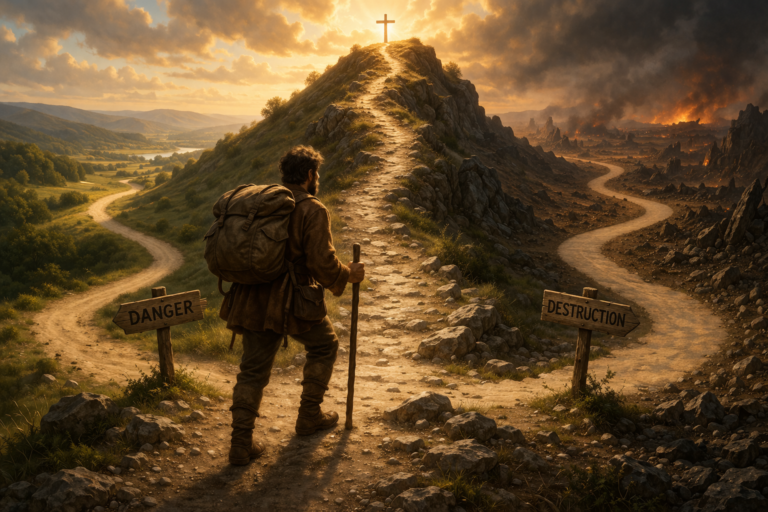
After a while the path began to rise. It was not steep at first, just enough to make his legs burn and his breathing shorten. Christian did not know why the road climbed here. He only knew he could not go back. The gate was behind him. The City of Destruction was behind him. Wherever this road led, he had to follow it.
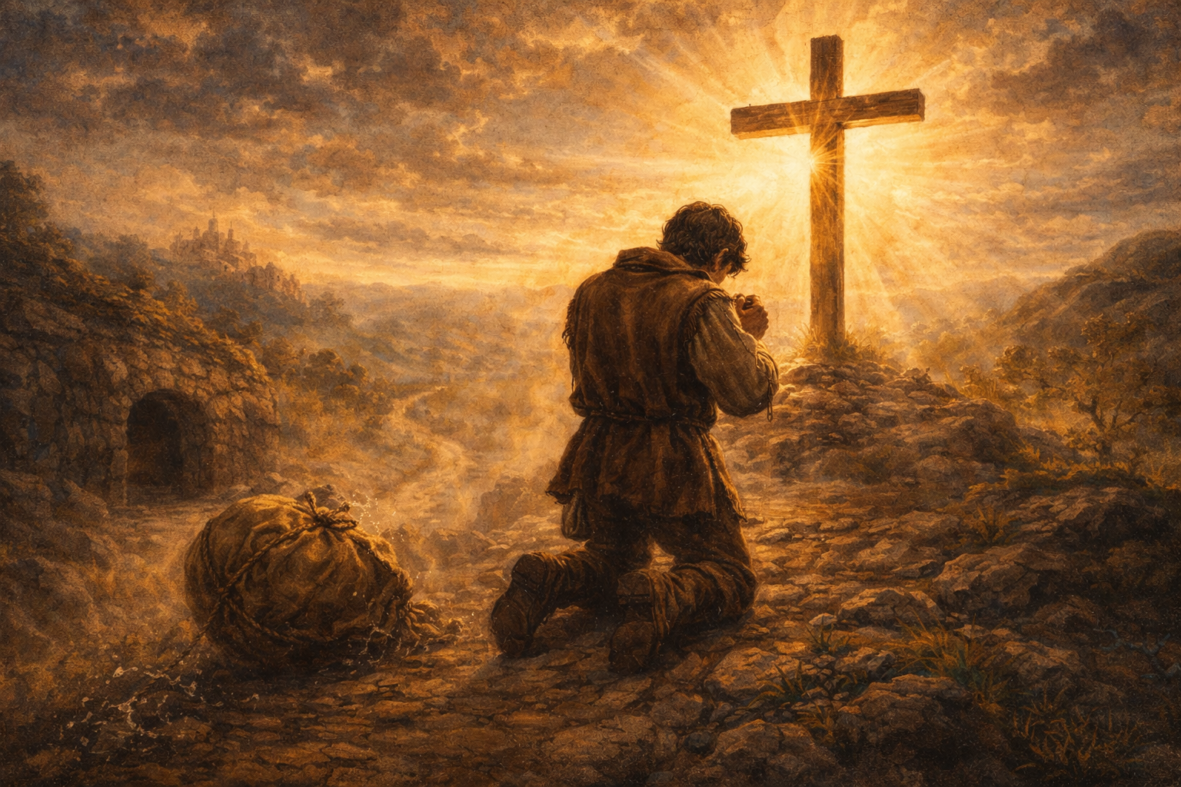
At the top of the hill stood a cross.
It was not surrounded by crowds. No soldiers. No noise. Just a rough beam of wood standing against the sky, like something left there long ago. And yet the closer Christian came, the more it felt like the whole road had been leading to this place.
He took another step.
Then another.
And without his hands touching the straps, without him trying to loosen anything, the burden shifted.
It slid from his shoulders, struck the ground behind him, and began to roll.
Down the hill it went, faster than he could follow, until it disappeared into the mouth of a sepulcher and was gone.
Christian stood there for a moment, hardly breathing.
His back felt light.
His chest felt open.
For the first time since the journey began, he was not carrying what he had always carried.
And before he could explain it, joy came with the freedom.
What the Burden Really Was
Bunyan is not vague here. The burden on Christian’s back is not just sadness or regret. It is the weight of sin before a holy God.
The law had already shown him that.
When the dust was stirred in Interpreter’s house, Christian learned what the commandments do. They reveal what is already there. They make the dirt visible. Once he saw it, he could not unsee it. Once he knew he was guilty, he could not pretend he was not.
Paul describes the same thing in Romans 7. The law shows sin, but it cannot remove it. It tells the truth, but it cannot rescue the sinner.
That is why the burden stayed on his back no matter how far he walked.
It could not be worked off.
It could not be ignored.
It could not be carried long enough to disappear.
The weight was not physical. It was the guilt of sin under the law of God.
And that kind of burden has to be taken away.
No Condemnation
When the burden falls at the cross, Bunyan is showing what Scripture calls justification.
“There is therefore now no condemnation for those who are in Christ Jesus” Romans 8:1.
No condemnation does not mean no sin ever happened.
It means the penalty has already been dealt with.
Justification is not God pretending we are righteous.
It is God declaring us righteous because Christ has taken what we deserved.
“But He was pierced through for our transgressions,
He was crushed for our iniquities;
The chastening for our peace fell upon Him,
And by His wounds we are healed” Isaiah 53:5.
At the cross the burden does not vanish into nothing.
It falls because it has been paid for.
“Having forgiven us all our transgressions, having canceled out the certificate of debt… having nailed it to the cross” Colossians 2:13–14.
Christian did not untie the burden.
He did not cut the rope.
He did not earn the freedom.
He came to the cross, and the cross did what he never could.
Why Joy Comes After Justification
It is not an accident that Bunyan gives Christian joy the moment the burden falls.
Condemnation crushes the soul.
A person can keep walking, keep trying, keep doing the right things, but the weight steals peace. It makes every step feel uncertain. It makes you wonder if you will ever be able to stand straight again.
Some believers live like the burden is still tied to their back, even though Christ already removed it. They remember their sin more clearly than they remember the cross. They measure themselves by the law instead of resting in grace.
But Scripture does not say less condemnation.
It says no condemnation.
When the burden fell, Christian did not become perfect.
He became forgiven.
And forgiveness brings a kind of joy effort never can.
Walking the Road Without the Weight
The road did not end at the cross.
Christian still has hills ahead of him. He will face danger, confusion, fear, and more than one moment when the path feels harder than he expected. The journey is not finished just because the burden is gone.
But everything is different now.
“Let us also lay aside every encumbrance and the sin which so easily entangles us… fixing our eyes on Jesus” Hebrews 12:1–2.
The pilgrim still walks.
He still struggles.
He still grows.
But he does not walk condemned.
The cross does not remove the road.
It removes the weight that made the road impossible.
The Road After the Cross
Christian will meet trouble again soon. Bunyan will not let the story stay easy for long. There will be fear, false guides, steep climbs, and dark valleys before the journey is over.
But one thing will never return.
The burden is gone.
Once it falls at the cross, it never goes back on his shoulders.
And a pilgrim who walks forgiven walks differently.
He stands straighter.
He breathes deeper.
He keeps going.
Not because the road is light.
Because the guilt is gone.