
Why Does the Bible Start the Christmas Story in the Garden of Eden?

If you open your Bible looking for the first hint of Christmas, you might expect to begin in Luke with shepherds or in Matthew with a star. But Scripture does something far more surprising. It walks you past the manger, back through Bethlehem, beyond Abraham and Moses and Noah, all the way to a garden filled with trees and sunlight and the sound of a serpent whispering lies.
Christmas begins in Eden.
Not because Mary or Joseph were there. Not because angels were singing over the rivers of the ancient world. Christmas begins in Eden because that is the moment the world learned it needed one.
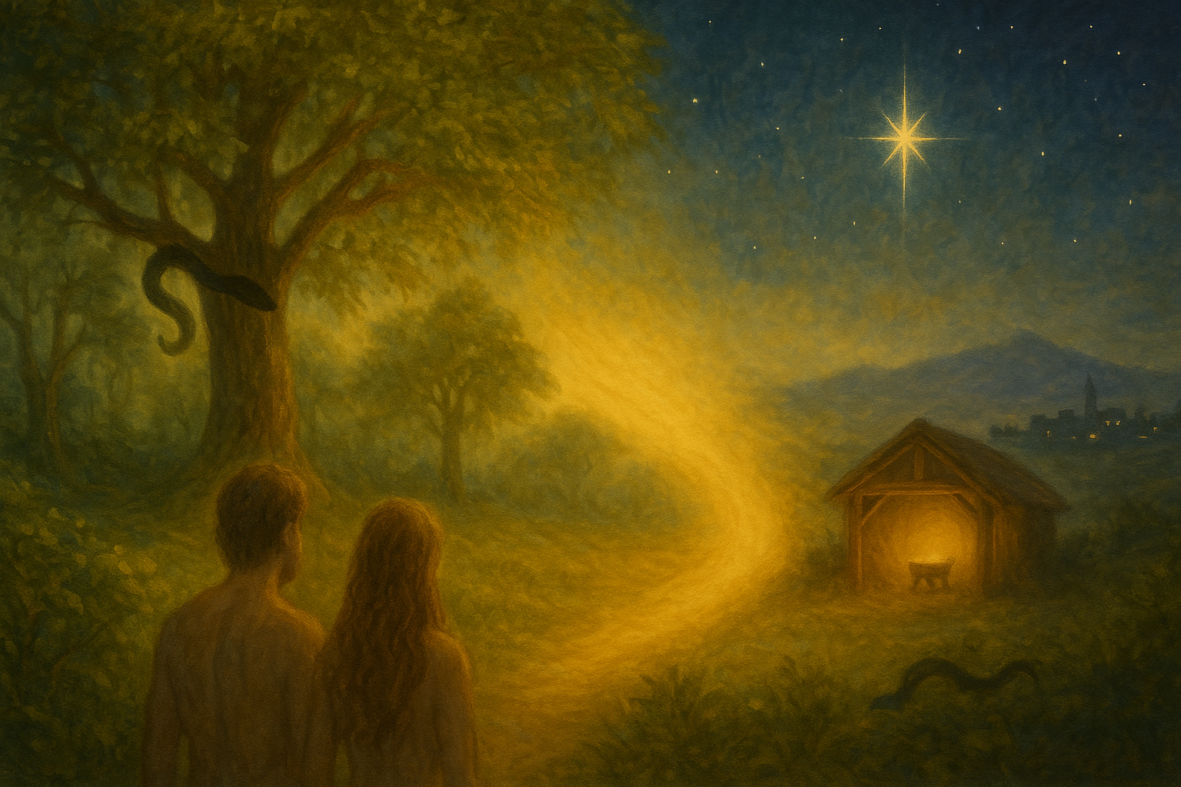
The story turns on a single verse. Adam and Eve stand before God, hearts heavy with shame, the serpent coiled nearby in quiet triumph. Everything is broken. Everything is scarred. The world is only three chapters old and already groaning for rescue. And into that silence God speaks the very first promise of Christmas.
He looks at the serpent and says that a Child will come. The Child will be born of a woman. The serpent will strike His heel, but He will crush the serpent’s head (Genesis 3:15). That sentence is the first gospel. The first prophecy. The first faint melody of a song that will swell across the pages of Scripture until it reaches a manger in Bethlehem.
Your Prophecy of Christmas notes capture this movement so well. They begin with Eden, not Bethlehem, because Christmas is not a sentimental holiday. It is part of the bigger picture of God’s plan that started the moment sin entered the world (Reighley, 2018c). Eden is the birthplace of the promise because Eden is the birthplace of the problem.
Once you see this, the whole Bible unfolds like a trail of clues pointing to a coming Redeemer. Every covenant, every sacrifice, every prophet, every king is a step along a path that leads back to that verse spoken in the garden.
When Noah survives the flood, the promise lives.
When Abraham hears that his offspring will bless the nations, the promise sharpens.
When Judah receives the scepter in Genesis 49, the promise advances.
When David is told a son will sit on his throne forever, the promise nearly breaks into song.
The Old Testament is not a random stack of ancient stories. It is a careful unfolding of God’s determination to keep a promise He made in Eden.
By the time we reach Isaiah, the promise has become poetry. A virgin will conceive. A son will be born. His name will be Wonderful Counselor and Mighty God. Nations will rise and fall at His coming. Darkness will flee from His light. And when we arrive at Micah, the promise becomes a pinpoint on a map. The Child will be born in Bethlehem. A stable is waiting. A manger is being carved. The stars are shifting into place.
All of this flows from that single moment in Eden. The Christmas story begins there because sin begins there. And sin is not a surface problem. It is not bad behavior. It is a broken relationship with the God who made us. Christmas begins in Eden because the world needed more than advice. It needed rescue. It needed God to step into His creation and heal what humanity had shattered.
And so when the New Testament opens, and an angel appears to Mary and says she will bear a Son who will reign forever, heaven is not improvising. It is fulfilling. The promise spoken in the garden finally becomes flesh and cries in a manger. The serpent who listened to God’s words in Eden now listens again in panic as shepherds run across fields and angels fill the sky with glory. The Child has arrived.
But the shadow of Eden still lingers. The serpent has not forgotten the prophecy. That is why Herod rages in Matthew 2. That is why Revelation 12 shows a dragon waiting to destroy the Child before He can begin His mission. Your Christmas theology notes remind us that the unseen realm was active at the Nativity, because the birth of Jesus was part of God’s cosmic plan to undo the works of the devil (Reighley, 2018b). The manger is an act of mercy and an act of war.
And yet, God conquers not by force, but by humility. The eternal Word becomes flesh. He enters the world as a Child. He grows, He teaches, He heals, He suffers, He dies, and He rises. The heel is bruised. The serpent’s head is crushed. What began with a whisper in the garden ends with a shout on an empty Sunday morning.
This is why the Bible starts the Christmas story in Eden. Because Christmas is not fundamentally about a birth. It is about a promise. A promise made by God to redeem a world that had fallen. A promise kept through centuries of faithfulness. A promise that became a person whose name is Jesus.
And it matters for you because it means your story is not an accident. The same God who kept His word for thousands of years will keep His word to you. The same God who entered the brokenness of Eden will enter the brokenness of your life. The same God who brought light into a world shadowed by sin will bring light into whatever darkness you carry.
Christmas begins in Eden, but it does not end there. It ends at a cross, and then at an empty tomb, and then at a throne where the risen Christ reigns forever. And one day it will end in a new creation where the serpent never speaks again.
Until then, hold onto the promise that has held onto humanity since the first pages of Scripture. The God who began His Christmas story in Eden is still writing redemption into the world, and into your life, every single day.
References
Beale, G. K. (1999). The book of Revelation. Eerdmans.
Heiser, M. S. (2015). The unseen realm: Recovering the supernatural worldview of the Bible. Lexham Press.
Reighley, C. (2018b). The theology of Christmas [Teaching notes]. RHCC Bible Study.
Reighley, C. (2018c). The prophecy of Christmas [Teaching notes]. RHCC Bible Study.
Walton, J. H. (2006). Ancient Near Eastern thought and the Old Testament. Baker Academic.