
Did a Dragon Really Show Up at the First Christmas?

Most of us grew up imagining Christmas as a quiet night. A barn lit by soft lantern light. Sheep politely minding their manners. Mary glowing with maternal peace. An angel perched above the stable like a delicate tree topper.
It is a lovely picture.
It is also far too quiet.
Because the Bible tells another Christmas story. A stranger one. A louder one. A story that begins before Bethlehem, before shepherds and stars, before Joseph could even process what Gabriel had told him. It begins in the Garden of Eden with a serpent who had been watching and waiting for the promised Child who would one day crush his head.
John sees that story.
And he sees a dragon.
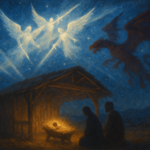
Not a cartoon dragon breathing fire into the hay. Something older. Something spiritual. Something that has stalked the pages of Scripture since Adam and Eve hid among the trees. In Revelation 12 John watches a woman in labor and a great red dragon standing in front of her, ready to devour the Child the moment He is born. The woman represents Israel, the covenant people through whom the Messiah would come. The Child is the One who will rule all the nations with a rod of iron, which clearly identifies Him as Jesus based on Psalm 2.
Your own Christmas teaching calls this moment a manger full of dragon drool (Reighley, 2018b).
That image stays with you. It reminds us that Revelation is not inventing a new story. It is pulling back the curtain on the one we already know. The stable in Bethlehem looked peaceful from the outside. From heaven’s viewpoint it looked like a battlefield.
The Gospels give us the ground-level view. Mary and Joseph. Angels speaking courage into frightened hearts. A manger because there was no room in the guest space. Shepherds hurrying through the night to find a newborn King. Quiet wonder. Awe. Fragile beginnings.
Revelation gives us the sky-level view. Ancient hostility. Cosmic tension. A dragon crouched at the threshold of history. The Child the dragon long feared finally entering the world. The two pictures fit together like layers on a map. One shows what human eyes could see. The other shows what was really happening.
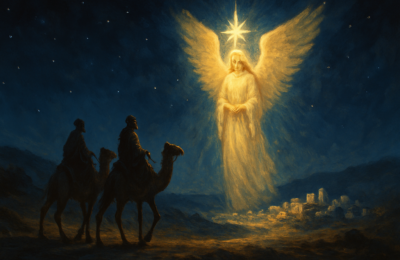
And you can feel the dragon’s shadow in Matthew 2. Herod hears a rumor of a King who is not him. He panics. He lies to the magi. When his plan fails, he lashes out against the children of Bethlehem. It sounds cruel. It is also familiar. It is the same old serpent still fighting the same old war. This time the rage is wearing a crown.
Revelation 12 is not saying Mary saw a literal dragon in the hay. No Gospel writer describes that. But John is telling the truth all the same. The enemy who opposed the promise in the garden was present in the invisible places of Bethlehem. He was not sleeping. He was not ignoring the moment. He was desperate to stop it.
Apocalyptic writing helps us understand this. The Bible often uses symbolic creatures to reveal spiritual realities. In the Ancient Near East dragons represented chaos and spiritual rebellion. The Old Testament uses this imagery to describe powers that resist the purposes of God (Walton, 2006). Revelation carries this forward. The dragon is not a myth borrowed from pagan stories, as Beale (1999) notes, but the serpent of Genesis 3 seen in his full, terrible form.
This means Christmas is not a soft story. It is not sentimental. It is strategic. The Incarnation is the moment God steps into a world that is ripping at the seams. The eternal Son humbles Himself and enters the very creation the dragon has been spoiling since Eden (Philippians 2 in Reighley, 2018b). Jesus does not avoid the battlefield. He comes directly into enemy territory.
Revelation says the dragon tries to destroy the Child. Matthew shows us Herod trying to do the same. The serpent has always used earthly powers when it suits him. But before the dragon can strike, the Child is caught up to God and to His throne. The attempt fails. The serpent misses again.
And that miss is fatal because it leads to the cross. The one place the dragon believed he could win becomes the place where Jesus breaks his power forever. Hebrews says Jesus shared our flesh so that through His death He might destroy the one who held the power of death (Hebrews 2 in Reighley, 2018a). The Nativity and the cross are not separate stories. They are chapters in one victory.
When you see Christmas this way, everything changes.
The angels in Luke are not singing lullabies. They are announcing a royal invasion.
The shepherds are not simply curious visitors. They are witnesses to the moment the King enters His world.
The manger is not a sweet scene. It is a forward outpost in an occupied land.
And the baby is not fragile. He is fearless.
He is the Champion who came to destroy the works of the devil (1 John 3 in Reighley, 2018a).
So did a dragon really show up at the first Christmas
The answer is yes, although not in a way that ruins your nativity set. The dragon was there in the unseen realm, raging and resisting, just as he had from the beginning. But his presence only highlights the beauty of the moment. The King arrived anyway. The promise moved forward. The light stepped into the darkness and the darkness could not overcome it.
And because of that, when your own life feels pressed by shadows, take heart. The Child in the manger is the champion on the throne. The serpent still thrashes, but the victory is already His. Hold fast. Lift your head. This story ends with glory.
And if you ever do add a dragon to your nativity set, place him at Mary’s feet. That is where all serpents belong.
References
Beale, G. K. (1999). The book of Revelation. Eerdmans.
Heiser, M. S. (2015). The unseen realm: Recovering the supernatural worldview of the Bible. Lexham Press.
Reighley, C. (2018a). The purpose of Christmas [Teaching notes]. RHCC Bible Study.
Reighley, C. (2018b). The theology of Christmas [Teaching notes]. RHCC Bible Study.
Reighley, C. (2018c). The prophecy of Christmas [Teaching notes]. RHCC Bible Study.
Walton, J. H. (2006). Ancient Near Eastern thought and the Old Testament: Introducing the conceptual world of the Hebrew Bible. Baker Academic.