
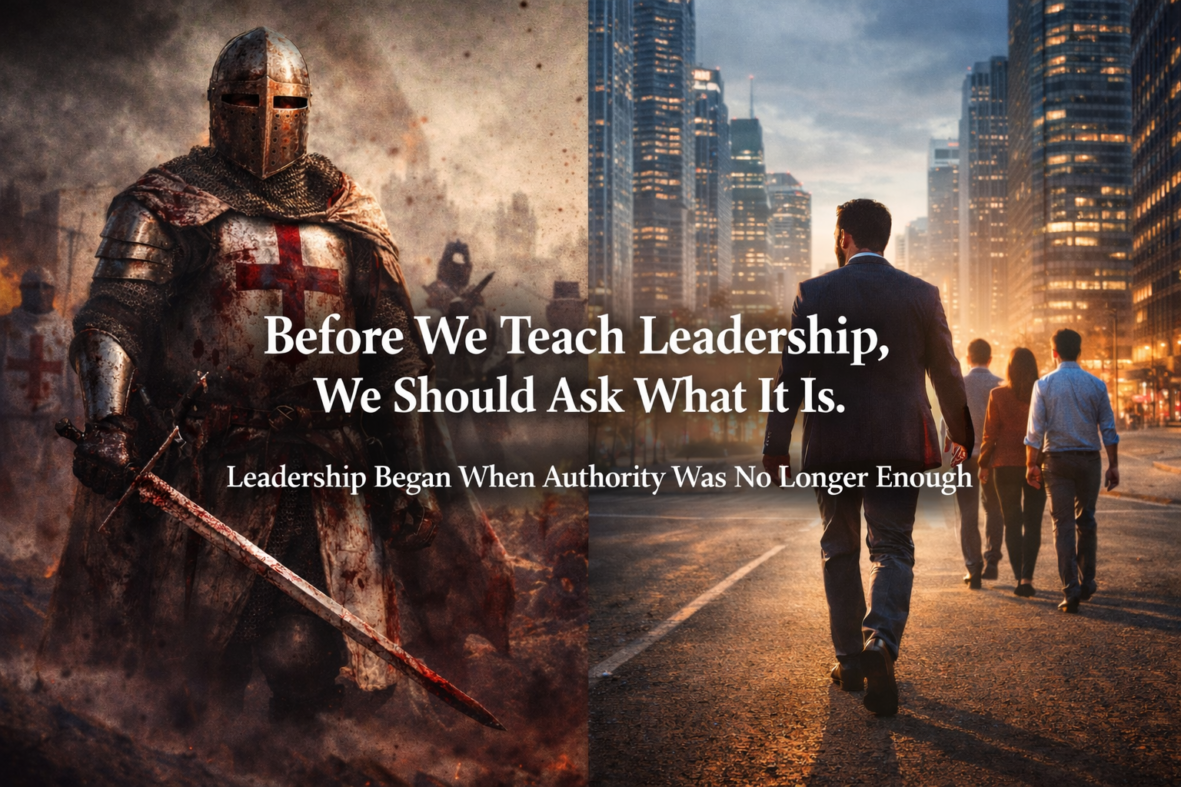
Leadership Began When Authority Was No Longer Enough
This article was originally published on LinkedIn for the Wisdom & Wit Newsletter
I began my doctoral work in Strategic Leadership at Liberty University shortly after completing my master’s at Texas A&M University – The Bush School of Government and Public Service. Between the two degrees, I encountered the word leadership so often I began to suspect it was embedded in the Wi-Fi.
- Leadership theory.
- Leadership models.
- Leadership frameworks.
- Leadership assessments.
If there were a frequent flyer program for the word “leadership,” I would have earned lifetime status.
And to be clear, the study was rigorous and deeply valuable. We examined transformational leadership, servant leadership, adaptive leadership, transactional leadership. We evaluated research. We debated context. We wrestled with application.
But somewhere in the middle of all those models, I found myself asking a simpler question:
Before we talk about how to lead… have we stopped to ask what leadership actually is?
And even more fundamentally:
What is a leader trying to do?
The Surprising Newness of Leadership
Leadership feels ancient.
Kings have ruled for thousands of years. Generals have commanded armies since before recorded history. Patriarchs governed tribes. Prophets confronted nations.
But the formal academic study of leadership is shockingly new.
Systematic leadership theory did not meaningfully emerge until the late nineteenth and early twentieth centuries. “Great Man” theory dominated the early 1900s. Trait theory followed. Behavioral and contingency models developed mid-century. Transformational leadership as a framework does not appear until the late 1970s.
Humanity has had rulers for millennia.
We have only been studying leadership for about a century.
That timing is not accidental.
When Authority Was Enough
For much of history, leadership as a distinct idea was unnecessary because authority structures were assumed.
- Kings ruled by birthright.
- Generals commanded by rank.
- Patriarchs governed by tradition.
Obedience flowed from position.
Authority was enough.
But the modern world changed that equation.
The rise of constitutional government.
The expansion of democratic institutions.
Industrialization and large organizations.
Mass education.
Information access.
As societies democratized and institutions grew more complex, authority became conditional.
Position no longer guaranteed followership.
And that is when leadership, as we understand it today, became necessary.
Leadership emerged as a distinct idea when authority was no longer unquestioned. At its root it means guide or path-finder, and at its heart it is the relational process of influencing others toward a shared direction.
When authority alone could not command movement, someone had to create it.
Guide, Not Just Ruler
The Old English word lædan means “to guide,” “to go before,” “to bring along.” A leader is not first a ruler. A leader is one who goes ahead on a path and invites others to follow.
That is directional language.
- Leadership is about movement.
- Leadership is about orientation.
- Leadership is about responsibility for direction.
We often confuse leadership with position. If someone holds a title, we assume they are leading.
But position grants authority. It does not automatically create direction.
A leader, at the most basic level, answers the question:
Where are we going?
And that question is never neutral.
Influence and Moral Weight
Modern leadership scholarship defines leadership as a process of influence toward a common goal. That is a strong definition. It captures something essential.
- Leadership involves people.
- Leadership involves direction.
- Leadership involves movement toward something shared.
But here is the part we often miss.
Direction implies judgment. It implies that something is worth pursuing. It implies responsibility for outcomes.
From a biblical worldview, leadership has always carried that moral weight. Long before leadership became a university discipline, Scripture described leaders as shepherds, stewards, and watchmen. The imagery was not domination but care. Not coercion but guidance. Not self-exaltation but accountability.
A shepherd does not merely stand above the flock. He walks ahead of it.
Leadership, then, is not simply about moving people. It is about guiding people toward what is good, wise, and life-giving.
Authority can demand compliance. Leadership must cultivate commitment.
And commitment only comes when people trust both the direction and the one setting it.
What Is a Leader Actually Doing?
Strip away the terminology. Remove the models. Forget the assessments for a moment.
What is a leader actually doing?
At its core, a leader creates clarity about direction and aligns people toward it.
- Not manipulating.
- Not merely motivating.
- Not just maintaining systems.
Guiding.
That guidance requires discernment. It requires courage. It requires the humility to recognize that holding authority does not automatically mean you are leading.
- It is entirely possible to manage processes and never clarify purpose.
- It is entirely possible to enforce standards and never articulate vision.
- It is entirely possible to hold power and never guide anyone forward.
Authority can secure short-term obedience. Leadership seeks long-term alignment.
And alignment only happens when people understand both the destination and the reason for the journey.
Why This Matters Now
We live in a time of fragile institutional trust. Titles do not automatically generate followership. Organizational charts do not create influence. People do not follow simply because they are told to.
Which means leadership is more necessary now than ever.
- Not louder leadership.
- Not more charismatic leadership.
But clearer leadership.
If leadership emerged when authority was no longer enough, then every modern leader must wrestle with this:
- Am I relying on my position, or am I creating direction?
- Am I demanding compliance, or cultivating commitment?
- Am I assuming people will follow, or inviting them into shared purpose?
Because leadership is not first about power.
It is about responsibility for direction.
And that is a heavier calling than simply holding a title.
I would genuinely love your thoughts.
Before we debate leadership styles and models, how would you answer the simpler question:
What is a leader actually trying to do?