

This article was originally published on LinkedIn for the Wisdom & Wit Newsletter
Introduction: Formation, Experience, and a Moment That Made Me Pause
I came across a statement recently from a Texas political leader about a “Stop ICE” rally. Hundreds, maybe thousands of people. Raw emotions. Tears. Stories. Pain. A call to keep standing together until “the change we seek” finally comes.
I didn’t read it and think, That’s fake.
I didn’t roll my eyes.
I didn’t doubt the sincerity.
Pain is real. Fear is real. Family separation is real. Scripture never tells us to harden our hearts to that. God has always cared about the vulnerable, the outsider, the one who feels unseen.
But as I read it, I found myself slowing down.
Not to argue.
To think.
What kind of protest culture have we become?
That question matters to me more than some people might realize.
I didn’t grow up suspicious of law enforcement. Quite the opposite. My father was an FBI agent. His father was a South Carolina State Patrolman. Respect for law, order, and public service wasn’t something we debated. It was just part of the air we breathed. I learned early that “authority” isn’t some abstract idea. It’s carried by real people who put on uniforms, say goodbye to their families, and walk into situations most of us would rather avoid.
Later in life, I saw another side of things.
Through Christian disaster relief work, I spent time in neighborhoods that had been flattened. Homes torn apart. Families overwhelmed. People standing in front of what used to be their lives.
We didn’t ask who they voted for.
We didn’t ask where they came from.
We didn’t check paperwork.
We showed up with food, water, prayer, and presence. We served in the name of Jesus. Anyone who needed help mattered.
No qualifiers.
Those two worlds shaped me.
Law and compassion.
Order and mercy.
Structure and service.
And over time, I’ve become convinced Scripture never meant for us to choose between them.
So when I see protests framed only in emotional terms, or institutions dismissed as hopelessly corrupt, or obedience treated as weakness, I don’t just think politically.
I think biblically.
Because the question isn’t whether Christians should care.
We must.
The question is how we care without losing our bearings. Without trading truth for outrage. Without trading order for noise.
How do we walk this out faithfully?
Protest in American History: Reform, Not Rejection
One of the mistakes we make in moments like this is pretending protest is new.
It isn’t.
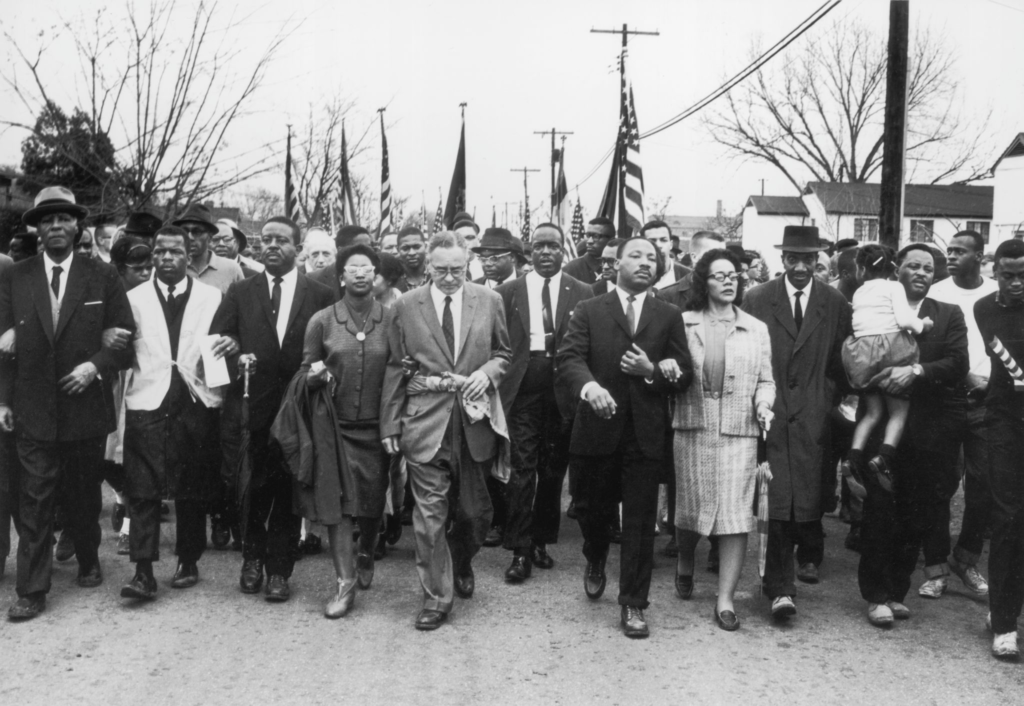
Some of the most important changes in American history came through public resistance to injustice. The Civil Rights Movement is the clearest example. Leaders like Martin Luther King Jr. didn’t just appeal to emotion. They appealed to Scripture. To moral law. To the Constitution. In his “Letter from Birmingham Jail,” King didn’t argue that authority was meaningless. He argued that authority had to answer to a higher standard.
That’s a crucial difference.
At its best, earlier protest worked inside a shared moral framework. People assumed that law mattered. Courts mattered. Institutions mattered. Even when those institutions were deeply flawed, they weren’t treated as illusions. Protest aimed to correct the system, not burn it down.
There was also a willingness to suffer quietly.
Arrest. Jail. Social cost.
Those weren’t badges of virtue. They were prices people were willing to pay for conscience. Breaking the law was rare and symbolic, not routine and celebrated. It was meant to expose injustice, not normalize disorder.
Even later movements, whether labor reform or anti-war activism, still largely assumed that persuasion, voting, and institutional change were legitimate ways forward. There was anger. There were excesses. There were mistakes. But there was still a sense that the system could be reformed.
In simple terms, protest used to sound like this:
“This law is wrong.”
“This policy is unjust.”
“This practice violates our values.”
Not:
“Nothing here is legitimate.”
The framework was still intact.
Law was still law.
Authority was still authority.
Reform was still possible.
Something has shifted since then.
And if we don’t understand that shift, we’ll keep talking past each other, reacting instead of discerning, and confusing noise for faithfulness.
What Has Changed: The Cultural Shift Beneath the Surface
If you spend any time paying attention to public life right now, you can feel it.
Something is different.
Not just louder.
Not just angrier.
Different in its logic.
Part of this shift has to do with how we now understand ourselves. Thinkers like Charles Taylor have described how modern Western culture has moved toward what he calls expressive individualism. In plain terms, it’s the idea that my deepest identity comes from my inner feelings, and that those feelings deserve public recognition and affirmation.
So instead of asking, “Is this true?”
We ask, “Is this authentic to me?”
Instead of asking, “Is this right?”
We ask, “Does this reflect my experience?”
That may sound harmless. But it changes everything.
When personal experience becomes the highest authority, shared standards begin to fade. Law becomes negotiable. Tradition becomes suspect. Institutions become obstacles instead of stewards.
Layer on top of that the collapse of trust in almost every major institution: government, media, courts, churches, universities. Decades of scandals, failures, and polarization have taken their toll. People don’t give systems the benefit of the doubt anymore. They assume corruption first and ask questions later.
Add social media to the mix.
Now outrage travels faster than reflection. Emotional stories spread farther than careful analysis. Movements form in hours instead of years. Leadership becomes optional. Accountability becomes blurry.
What used to take decades to build now takes a weekend.
And what used to require discipline now requires a hashtag.
So protest culture has changed.
It’s less rooted.
Less patient.
Less anchored.
It’s driven more by identity than by principle. More by narrative than by law. More by feeling than by formation.
That doesn’t mean people aren’t sincere. Many are.
But sincerity is not the same as wisdom.
And emotion is not the same as truth.
When a culture trains people to trust their inner voice more than any external authority, protest stops being about reform and starts becoming about self-expression. It becomes less about “Let’s fix this” and more about “Let me be heard.”
And that’s a fragile foundation.
A Biblical Framework: Prophetic Protest vs. Spiritual Rebellion
Scripture has seen moments like this before.
That’s one of the gifts of the Bible. It doesn’t just give us commands. It gives us patterns. Stories. Warnings. Mirrors.
And when it comes to resistance and authority, one of the clearest contrasts in the Old Testament is between Elijah and Korah.
Both confronted leadership.
Both challenged power.
Both spoke up.
Only one was faithful.
Elijah stood before King Ahab, one of the most corrupt rulers in Israel’s history. He didn’t flatter him. He didn’t soften his words. He didn’t avoid conflict. But notice how Elijah speaks.
“Thus says the Lord.”
Every confrontation is anchored in God’s Word. God’s covenant. God’s authority.
Elijah isn’t saying, “I don’t like your leadership.”
He’s saying, “You have violated God’s law.”
He submits upward before he speaks outward.
That’s prophetic protest.
Now look at Korah in Numbers 16.
Korah also sounds moral. Even spiritual.
“All the congregation is holy. Why do you exalt yourselves?”
It sounds democratic. Fair. Inclusive.
But God calls it rebellion.
Why?
Because Moses and Aaron weren’t self-appointed. God had placed them there. So Korah isn’t really challenging men. He’s challenging God’s structure.
He’s saying, in effect, “We don’t accept this order.”
Notice the difference.
Elijah appeals to God.
Korah appeals to group grievance.
Elijah points upward.
Korah points inward.
Elijah says, “God decides.”
Korah says, “We decide.”
That’s the heart of it.
Biblical protest is vertical before it is horizontal. It starts with reverence. With submission. With fear of the Lord.
Rebellion is horizontal. It starts with self. With resentment. With entitlement.
Scripture takes that difference very seriously.
Rebellion is not treated as “strong personality” or “passion for justice.” It’s treated as spiritual disorder.
“For rebellion is as the sin of divination” (1 Samuel 15:23).
That’s strong language.
Why?
Because when people reject God’s order, even in the name of good causes, they put themselves in the place of God.
And that never ends well.
This is where much modern activism quietly drifts.
Not always intentionally.
Not always consciously.
But functionally.
When movements say, “This institution has no moral authority,”
when they say, “We will decide what is just,”
when they say, “Obedience is weakness,”
they are walking Korah’s road, not Elijah’s.
And Scripture warns us where that road leads.
Jesus and the Cross: The Pattern We Cannot Ignore
If we are serious about thinking biblically, we can’t stop with Elijah and Korah.
Everything has to pass through Jesus.
And this is where a lot of modern Christian thinking quietly breaks down.
Jesus lived under unjust political authority.
We sometimes forget that.
Rome was not benevolent.
It was not democratic.
It was not accountable to the people it ruled.
It taxed heavily.
It ruled brutally.
It executed publicly.
And yet, Jesus never led a political revolt.
He never organized protests against Caesar.
He never stirred crowds against Roman soldiers.
He never framed His mission in political terms.
That doesn’t mean He ignored injustice.
He confronted hypocrisy relentlessly.
He exposed spiritual corruption.
He overturned tables in the Temple.
He rebuked false shepherds.
But notice where His sharpest words were aimed.
Not at Rome.
At religious leaders who misused God’s name.
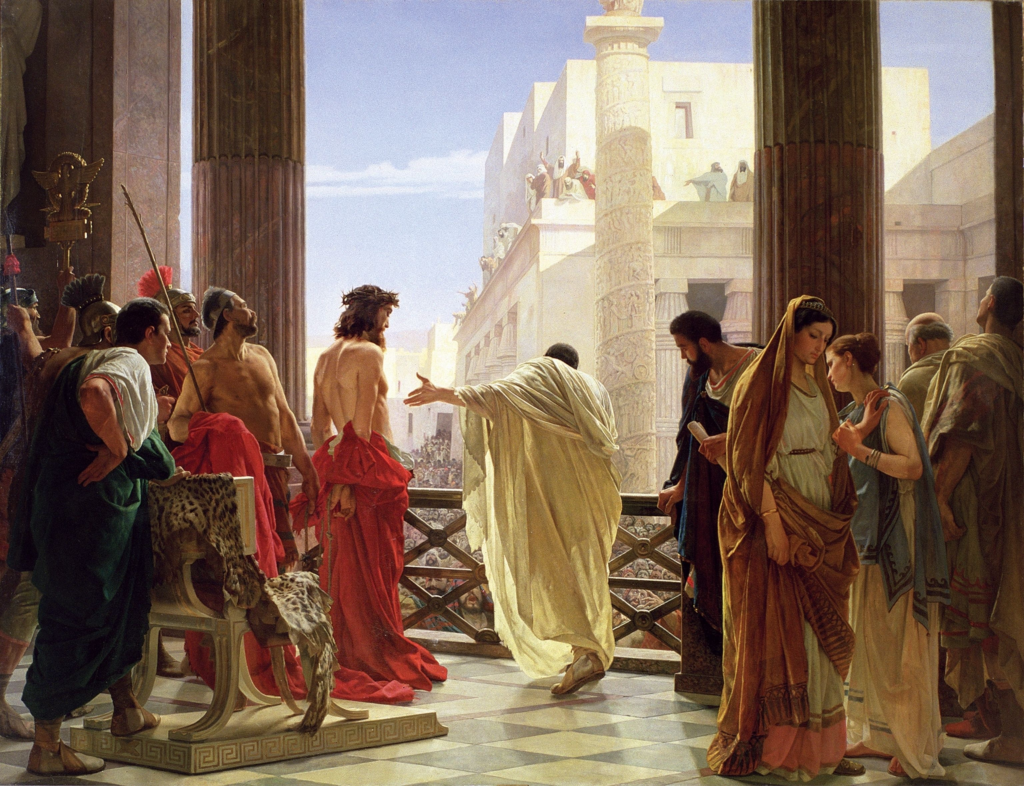
When He stood before Pontius Pilate, He was calm. Measured. Unthreatened.
“You would have no authority over Me unless it had been given you from above.”
That’s remarkable.
Jesus recognizes authority, even when it’s flawed, as derivative. Under God. Not ultimate.
He pays taxes.
He submits to arrest.
He forbids Peter’s violence.
He walks toward the cross.
Why?
Because His mission was deeper than regime change.
He didn’t come to overthrow Rome.
He came to overthrow sin.
He didn’t come to mobilize outrage.
He came to bear wrath.
He didn’t come to seize power.
He came to lay His life down.
That is the model.
Not passivity.
Not cowardice.
Obedient courage.
Costly faithfulness.
Truth without rebellion.
Love without lawlessness.
When Christians bypass the cross and rush to activism, we reverse Jesus’ order. We try to fix the world without being crucified to it first.
And that always distorts the witness.
Law and Compassion: A False Cultural Choice
One of the most damaging ideas in our public conversation right now is that we have to choose.
Choose between law and love.
Choose between order and empathy.
Choose between justice and mercy.
Scripture never gives us that option.
God is both just and compassionate.
Holy and merciful.
Righteous and gracious.
So His people are called to reflect both.
Law exists to restrain evil and protect the vulnerable. Without it, the strong dominate the weak. The loud dominate the quiet. The ruthless dominate the fragile.
Compassion exists to humanize systems. Without it, rules become weapons. Procedures become excuses. People become problems.
You need both.
My own life has taught me that.
Growing up around law enforcement, I saw the cost of maintaining order. The long hours. The pressure. The moral weight of split-second decisions. I learned early that “just do your job” is rarely simple.
Later, in disaster relief, I saw the cost of broken systems. Families falling through cracks. People overwhelmed by forces beyond their control. I learned that “personal responsibility” doesn’t erase suffering.
Both worlds are real.
And Scripture speaks to both.
Micah says God requires justice and mercy.
Paul says authority is ordained by God.
Jesus looks at crowds and has compassion.
Not either-or.
Both-and.
So when protests frame law as cruelty and compassion as virtue, something is wrong. And when responses frame compassion as weakness and law as ultimate, something is wrong.
Biblical faith refuses both extremes.
It insists that we protect people and preserve order.
At the same time.
Discernment: Learning How to Think Before We Join In
One of the quiet dangers of our moment is how quickly we are expected to react.
Something happens.
A video circulates.
A story spreads.
A narrative forms.
And almost immediately, there’s pressure.
Where do you stand?
Have you posted yet?
Why are you silent?
In that environment, discernment feels slow. Even suspicious.
But Scripture never tells God’s people to be fast reactors.
It tells us to be wise.
“Be wise as serpents and innocent as doves.”
That means thoughtful and humble at the same time.
So before Christians jump into any movement, any protest, any campaign, there are some honest questions we should be willing to ask. Not to be cynical. To be faithful.
Is Scripture actually shaping this movement, or just being quoted when convenient?
Is lawful authority being acknowledged, even while criticized?
Is persuasion valued, or is pressure the main strategy?
Is repentance part of the language, or only accusation?
Is there room for disagreement without being labeled immoral?
Is Christ visible here, or is He just a decoration?
Is humility present, or only certainty?
Those are uncomfortable questions.
They slow us down.
But that’s the point.
Wisdom almost always feels slow in an age of outrage.
And I’ve learned this over time: if a movement can’t tolerate thoughtful questions, it’s usually because it doesn’t want accountability.
That’s not a good sign.
The Danger of Moral Absolutism and Outrage Culture
Here’s something I’ve noticed over the years, both in ministry and in public life.
When people become convinced that their cause is purely righteous, everything else starts to slide.
Tone.
Truth.
Charity.
Patience.
All of it becomes optional.
We start hearing things like:
“Extraordinary times call for extraordinary measures.”
“The system is corrupt anyway.”
“Nice words won’t change anything.”
“You’re either with us or against us.”
That’s moral absolutism.
It’s the belief that my side is so right that normal moral limits no longer apply.
Scripture is deeply suspicious of that mindset.
James says human anger does not produce God’s righteousness.
Samuel says rebellion is like divination.
Proverbs warns that pride goes before destruction.
Why such strong language?
Because once people believe their righteousness is guaranteed, repentance disappears.
And when repentance disappears, cruelty follows.
Not always immediately.
Not always dramatically.
But steadily.
I’ve watched well-meaning people become hardened. Less patient. Less careful with words. Less willing to listen. More willing to justify things they never would have justified before.
All in the name of justice.
That’s not spiritual maturity.
That’s spiritual drift.
And outrage culture accelerates it.
When attention is rewarded for being angrier, louder, and more certain, wisdom gets crowded out. Nuance gets mocked. Humility gets labeled as weakness.
So the volume rises.
And the soul shrinks.
That’s not renewal.
That’s corrosion.
Faithful Presence: What Obedience Looks Like in a Fractured Age
So where does that leave us?
If protest culture has changed.
If outrage is easy.
If rebellion can dress itself up as righteousness.
If compassion and order both matter.
What does faithfulness actually look like now?
Honestly, it looks a lot less dramatic than social media would have us believe.
It looks like steady obedience.
It looks like Christians who take Scripture seriously, even when it’s inconvenient.
It looks like people who show up in their communities long after the cameras are gone.
It looks like teachers who care about kids.
Pastors who preach truth.
Volunteers who keep serving.
Neighbors who keep loving.
Citizens who keep engaging.
Families who keep praying.
It looks like people who work inside broken systems instead of just shouting at them.
It looks like believers who are willing to sit in tension. To hold law and compassion together. To resist the pressure to simplify everything into heroes and villains.
It looks like Christians who speak clearly when something is wrong, but who refuse to burn down what God is still using.
It looks like courage without cruelty.
Conviction without contempt.
Clarity without chaos.
That kind of faithfulness doesn’t trend.
It doesn’t go viral.
But it builds something that lasts.
Jesus didn’t tell His disciples to shake the world by shouting.
He told them to be salt and light.
Salt works quietly.
Light shines steadily.
Both take time.
Conclusion: Walking It Out Under Christ’s Lordship
When I think back to that political statement I read, I still don’t doubt the sincerity behind it.
I believe the emotion was real.
The stories were real.
The pain was real.
And Christians should never dismiss that.
But sincerity is not enough.
Passion is not enough.
Outrage is not enough.
What we need, especially in moments like this, is wisdom shaped by the Word of God. Hearts formed by Christ. Minds trained to think beyond headlines and hashtags.
I keep coming back to those two worlds that shaped me.
A family grounded in law enforcement, where order mattered and sacrifice was real.
Years in disaster relief, where compassion mattered and suffering was personal.
Both taught me something.
Both humbled me.
Both pushed me back to Scripture.
And Scripture keeps telling the same story.
God cares about justice.
God cares about mercy.
God establishes authority.
God confronts abuse.
God calls for repentance.
God offers grace.
Not one without the other.
All held together in Christ.
Jesus did not redeem the world by leading protests.
He redeemed it by carrying a cross.
He did not reject authority.
He submitted to the Father.
He did not shout down His enemies.
He prayed for them.
And then He rose.
That is our hope.
Not in movements.
Not in outrage.
Not in slogans.
In a risen King who is still at work, even in fractured times.
So maybe the question for us is not, “How loud can we be?”
Maybe it’s this:
How faithful can we be?
Faithful truth.
Lived grace.
Walking it out.
Selah.