

Could the Star of Bethlehem Have Been an Angel Instead of an Astronomical Event?

Most of us imagine the Star of Bethlehem as a brilliant cosmic marvel burning above the stable. A celestial flare bright enough to make seasoned astronomers pack up their charts, saddle their camels, and head west toward a land and a king they had never seen. But Matthew gives us a detail that does not behave like any star we know. It moves with intention. It leads travelers along a road. It stops above a single house in Bethlehem as if pointing a divine finger at the Child inside.
So here is the question.
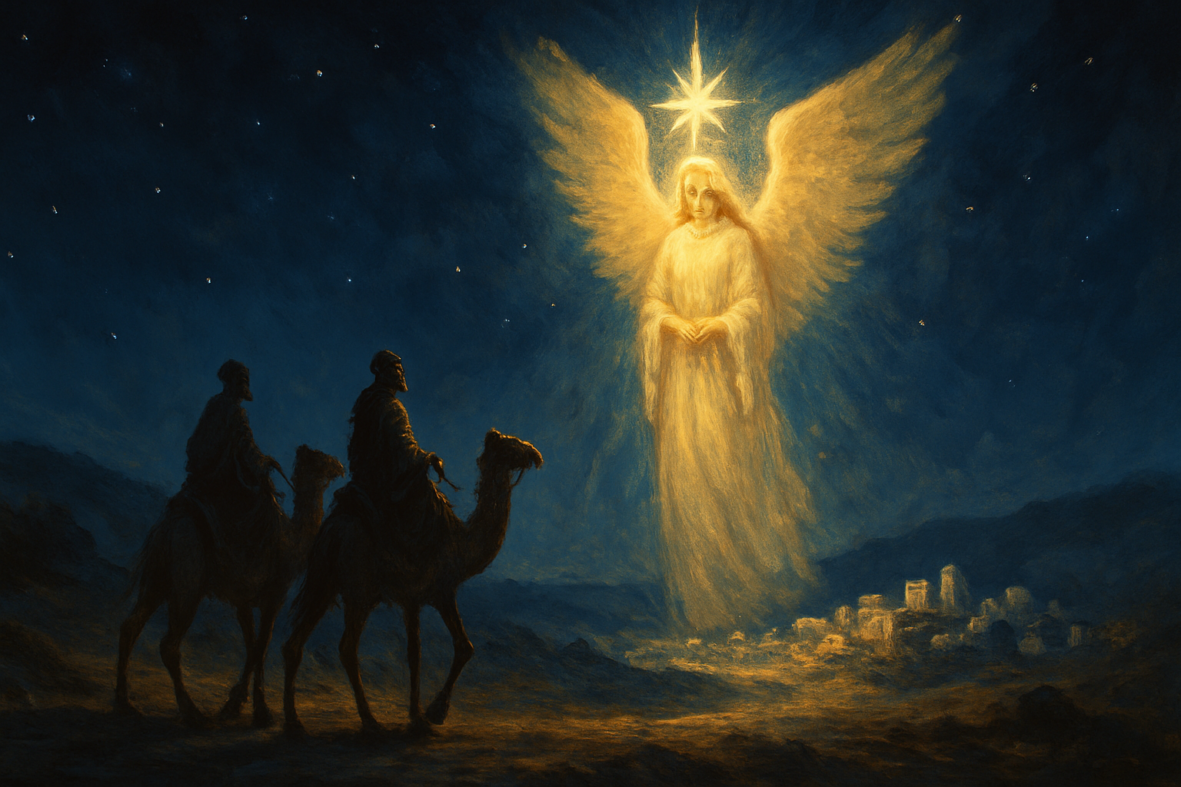
Could the Star of Bethlehem have been an angel instead of a natural astronomical event
The short answer is yes. It could have been. Scripture never identifies the star as a literal star in the modern scientific sense. The behavior Matthew describes fits an angelic messenger far better than it fits any known celestial phenomenon.
And here is the part that draws you in. The more closely you read Matthew’s account, the stranger and more beautiful the story becomes.
Let us look at why this question matters and why the answer is more than a curiosity about ancient astronomy.
The magi who saw the star were not dabbling astrologers watching the sky for entertainment. They were trained scholars from the East, shaped by centuries of Babylonian and Persian observation. They knew the heavens well enough to separate ordinary planetary motion from something truly extraordinary. When they saw this light rise, they recognized a heavenly message. Your Prophecy of Christmas notes highlight this moment as God calling Gentile seekers to the Jewish Messiah in a way they could understand (Reighley, 2018c).
Some scholars offer natural explanations. A conjunction of Jupiter and Saturn. A comet. A nova. These ideas have merit, and history records similar events. But none of these possibilities explain the behavior described in Matthew 2:9. The light does not remain fixed in the sky. It moves ahead of the magi on their journey from Jerusalem to Bethlehem. Stars do not lead travelers on specific roads. The light then stops over the house where Jesus is. Stars do not hover over single structures in first century Judea.
But angels can.
Throughout Scripture, angels often appear as radiant light that guides with intelligent purpose. The angel of the Lord goes before Israel as a pillar of fire, directing their path and stopping at precise locations (Exodus 13). The angels at Jesus tomb shine like lightning (Matthew 28). The shepherds in Luke 2 are surrounded by the glory of the Lord, which lights the night sky with overwhelming brilliance. Your Christmas theology notes rightly say that the Nativity is saturated with supernatural activity (Reighley, 2018b). Angels speak. Angels warn. Angels protect. Angels reveal. The whole story unfolds under heaven’s watch.
Even the word star in the ancient world has more flexibility than we often assume. The Greek aster can refer to celestial bodies, but it can also serve as a symbolic reference to heavenly beings. Job describes angels as morning stars singing at creation (Job 38:7). Revelation identifies angels symbolically as stars in Christ’s hand (Revelation 1:20). In the Ancient Near East, which Walton explains so clearly, luminous heavenly beings and luminous heavenly objects often overlap in meaning (Walton, 2006). Ancient readers would not have felt the tension modern readers feel when stars behave like persons.
Matthew may well be describing an angelic guide in language familiar to eastern scholars who interpreted the heavens as a canvas for divine messages.
To be fair, Scripture does not explicitly say the star was an angel. Matthew simply reports what the magi experienced. They saw a bright heavenly sign and followed it. Scholars such as Beale (1999) note that Revelation’s symbolic use of stars for angels does not prove an identical meaning in Matthew, but they also acknowledge that Matthew’s details do not fit known astronomical behavior.
The point is not to force a conclusion Scripture does not mandate. The point is to recognize that the Bible leaves room for us to marvel at the way God guided these travelers. Whether the light was a divinely positioned astronomical event or a luminous angelic messenger, it was a sign with intentionality. It was a light with a mission. It was heaven leading people to Christ.
And that is the part that matters most for us. God has always known how to guide those who seek Him. Sometimes through Scripture. Sometimes through providence. Sometimes through unexpected circumstances. Sometimes through quiet nudges in the heart. And sometimes, as with the magi, through light that moves with the tenderness of a messenger sent to lead weary travelers home.
If the star was an angel, it would only highlight what the Christmas story already tells us. Heaven was fully present at the birth of Jesus. Angels filled the night sky. A heavenly army sang over shepherds. Dreams warned Joseph. Messengers announced hope. And one more light guided strangers to the feet of the Messiah.
So could the star of Bethlehem have been an angel Yes. And whatever form that heavenly light took, it was doing what angels always do. It was pointing to Jesus.
And that is the light we still follow today.
References
Beale, G. K. (1999). The book of Revelation. Eerdmans.
Heiser, M. S. (2015). The unseen realm: Recovering the supernatural worldview of the Bible. Lexham Press.
Reighley, C. (2018b). The theology of Christmas [Teaching notes]. RHCC Bible Study.
Reighley, C. (2018c). The prophecy of Christmas [Teaching notes]. RHCC Bible Study.
Walton, J. H. (2006). Ancient Near Eastern thought and the Old Testament. Baker Academic.