
Was the Birth of Jesus an Act of War in the Unseen Realm?

Most of us imagine the birth of Jesus as the soft opening of a quiet night. A tired couple. A borrowed stable. A baby wrapped tightly against the cold. Angels singing somewhere out in the hills while shepherds blink into the dark and try to figure out what is happening.
But if you follow the storyline of Scripture, and if you let Revelation, the prophets, and the Gospels speak at the same table, another picture begins to form. It is older. It is sharper. And it is far from quiet. The moment Jesus entered the world, heaven did not whisper. Heaven declared war.
Not the kind fought with spears or swords. Something older. Something cosmic. Something written into the fabric of the story from the first time a serpent coiled its way into God’s garden.
To ask whether the birth of Jesus was an act of war is to listen again to a promise spoken in Eden. God looked the serpent in the eye and said that a Child would come. The Child would be wounded, but He would crush the serpent’s head (Genesis 3:15). That is not a lullaby. It is a battle plan. And in a very real sense, the Incarnation is the moment the promise steps into human history and breathes.
Your own Christmas notes capture this beautifully. The birth of Jesus is not merely a holiday. It is part of the bigger picture of God’s plan (Reighley, 2018c). The manger sits inside a war that has been underway since the beginning of time.
The prophets hint at this long before Bethlehem. Isaiah describes a Child who will shatter the oppressor’s rod and establish a kingdom that will never end. Micah speaks of a ruler whose origins are from ancient days. Daniel sees a Son of Man receiving dominion from the Ancient of Days. None of that imagery is soft. All of it points toward conflict, victory, and divine intervention.
When we finally reach the Gospels, the picture becomes clearer. The angel who visits Mary does not simply announce a baby. He announces a King whose reign never ends (Luke 1:33). When Joseph receives his dream, the angel does not simply reassure him. He tells him that this Child will save His people from their sins (Matthew 1:21). Salvation is not a casual word. It implies captivity, danger, and rescue. The birth of Jesus is the moment the Hero steps onto the field.
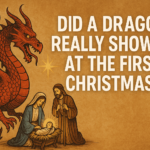
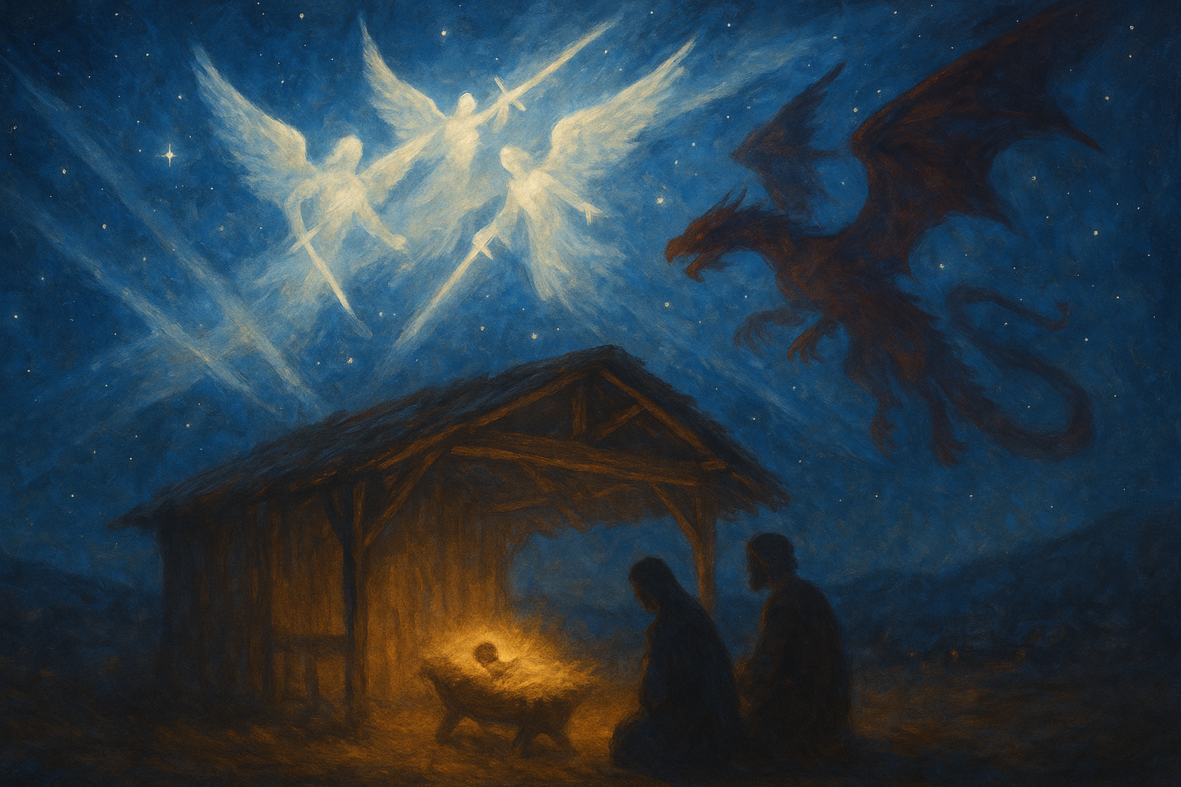
And then we reach Revelation 12, where the curtain is pulled all the way back. John sees the unseen realm as it truly is. A woman, representing Israel, cries out in labor. A dragon waits to devour the Child. The Child is born and is destined to rule all nations. War breaks out in heaven. Michael and his angels fight. The dragon loses and is thrown down in fury.
That is Christmas from the cosmic angle. That is what heaven saw when the shepherds saw light in the sky. It is not a stretch to say the birth of Jesus was an act of war. Revelation tells us exactly that. Something ancient collided with something eternal that night.
The New Testament epistles confirm this. Hebrews says Jesus took on flesh so He could destroy the one who holds the power of death (Hebrews 2:14). First John says the Son of God appeared so He might destroy the works of the devil (1 John 3:8). Your Purpose of Christmas notes emphasize the same truth. Jesus was born with a mission that was always leading toward confrontation and victory (Reighley, 2018a).
Even the details of the story show resistance. Herod’s slaughter in Matthew 2 is not political coincidence. It echoes Pharaoh’s attack on Israel’s sons and signals once again that spiritual opposition often uses earthly hands. The world into which Jesus was born was not neutral ground. It was contested territory.
But here is the wonder. God does not enter the war with spectacle. He enters hidden in humility. No armies. No thrones. Just a baby carried by a teenage mother and protected by a quiet man who listened to angels in his sleep. God fights by becoming vulnerable. He wins by becoming low. As Paul describes it, He emptied Himself and took the form of a servant (Philippians 2 in Reighley, 2018b). That is not the way any earthly kingdom wages war, yet it is the way heaven conquers.
So yes, the birth of Jesus was an act of war in the unseen realm. Not with earthly violence but with divine purpose. Not with iron and fire but with humility and incarnation. The manger is not separate from the battlefield. It is the opening move.
And that changes how we see our own lives. If God entered the war for us, then nothing we face is fought alone. The same Jesus who cried in a manger is the Jesus who crushed the serpent, the Jesus who rose from the grave, the Jesus who reigns at the right hand of the Father, and the Jesus who calls us into His life and His victory.
So when the Christmas lights fade and life feels heavy again, remember this. The Child who arrived in Bethlehem arrived with authority. He came into the darkness so the darkness would not have the final word. His birth was heaven’s declaration that the long war was nearing its end.
And one day the kingdom He began in a stable will fill the world with light.
References
Beale, G. K. (1999). The book of Revelation. Eerdmans.
Heiser, M. S. (2015). The unseen realm: Recovering the supernatural worldview of the Bible. Lexham Press.
Reighley, C. (2018a). The purpose of Christmas [Teaching notes]. RHCC Bible Study.
Reighley, C. (2018b). The theology of Christmas [Teaching notes]. RHCC Bible Study.
Reighley, C. (2018c). The prophecy of Christmas [Teaching notes]. RHCC Bible Study.
Walton, J. H. (2006). Ancient Near Eastern thought and the Old Testament. Baker Academic.