

A Tragic and Troubling Word

On September 10, 2025, a tragic act of violence stunned both political and Christian communities. Charlie Kirk, a nationally known conservative speaker, was gunned down at Utah Valley University. Prosecutors allege that the shooter, 22-year-old Tyler James Robinson, had been planning the attack for over a week. In the aftermath, reports surfaced of a chilling rationale: Robinson claimed he was “done with Kirk’s hatred” and, in effect, acted because life felt empty and irredeemable (AP 2025; Reuters 2025). Whether or not Robinson consciously embraced philosophy, commentators have not hesitated to describe his outlook as nihilistic a word that signals not just violence, but a worldview of despair.
But what does it mean to call someone a nihilist?
The term comes from the Latin nihil, meaning “nothing.” In its most basic sense, nihilism denies that life has inherent meaning, value, or moral grounding. The Encyclopedia of Philosophy defines it as “the rejection of all religious and moral principles, often in the belief that life is meaningless” (Pratt 2020). The Merriam-Webster dictionary echoes this, calling it “a viewpoint that traditional values and beliefs are unfounded and that existence is senseless and useless” (Merriam-Webster 2025).
Nihilism can take several forms:
- Existential Nihilism: life itself has no ultimate purpose; all human striving ends in nothing.
- Moral Nihilism: there are no objective right or wrongs, only human conventions.
- Epistemological Nihilism: we cannot know truth in any objective sense.
- Political Nihilism: social and political institutions are meaningless and ought to be dismantled.
In each case, the common denominator is meaninglessness. Nihilism is not just a philosophical footnote, it is a worldview that undercuts the very foundations of origin, identity, morality, and destiny. When someone says, “I killed him because life is meaningless,” that is not simply a confession of despair. It is a statement of worldview.
And that is precisely why Christians must pay attention. If nihilism represents the collapse of meaning, then the biblical worldview offers a coherent and life-giving alternative. Where nihilism says “nothing,” Scripture proclaims “In the beginning, God created the heavens and the earth” (Gen. 1:1, LSB). Where nihilism strips life of purpose, the Bible grounds it in the glory of God and the hope of resurrection.
The Roots of Nihilism: From Philosophy to Culture
Nihilism did not begin with a troubled young man in Utah. It has a long intellectual and cultural history, one that has profoundly shaped the modern world. To understand why commentators reach for the word “nihilist” when describing acts of violence or despair, we need to see where it came from.
Early Roots in Skepticism
The idea of “nothingness” as a philosophical problem reaches back into ancient skepticism. But it gained sharper form in modern Europe, where Enlightenment thinkers questioned the very foundations of truth, morality, and religion. By the late 18th century, German philosopher Friedrich Heinrich Jacobi warned that rationalist systems, if followed consistently, led not to truth but to nihilism, a collapse into nothing (Jacobi 1799). He meant that reason alone, detached from God and revelation, eroded all certainty.
Russian Nihilists
The word gained cultural traction in 19th-century Russia. Ivan Turgenev’s 1862 novel Fathers and Sons introduced the character Bazarov, a radical who rejects tradition, authority, and morality. Turgenev called him a nihilist, giving the world a picture of rebellion against all norms (Turgenev 1862). Russian radicals of the time embraced the label, using it to justify political violence and revolutionary agitation. To be a nihilist was to tear down, even if one had nothing constructive to build.
Nietzsche’s Diagnosis
Friedrich Nietzsche (1844–1900) took the conversation global. In The Gay Science and other works, Nietzsche declared that “God is dead” not as a theological statement, but as a cultural diagnosis (Nietzsche 1882). Modern Europe, having abandoned its faith in God, was left with no foundation for morality, truth, or meaning. For Nietzsche, this was the crisis of nihilism: the collapse of values in a post-Christian world. He warned that unless humanity created new values, nihilism would hollow out civilization.
Ironically, Nietzsche himself saw nihilism as something to be overcome, not celebrated. But his diagnosis stuck: without God, life really does reduce to “nothing.” It is not surprising, then, that later thinkers like Jean-Paul Sartre and Albert Camus wrestled with the “absurd” the attempt to live meaningfully in a meaningless universe (Sartre 1943; Camus 1942).
Modern Echoes
Nihilism is not confined to dusty philosophy books. It pervades culture today:
- Entertainment: Movies and streaming shows glamorize chaos, antiheroes, and dystopian despair.
- Youth culture: Phrases like “nothing matters” or “it’s all pointless” echo existential nihilism in meme form.
- Politics: Some activists embrace the destruction of institutions, traditions, or even lives—as if tearing down were itself a meaningful act.
- Personal despair: Suicide, addiction, and violence often sprout from the soil of perceived meaninglessness.
Whether in philosophy, literature, or culture, nihilism’s common thread is this: if God is absent, life becomes empty. As Paul put it, “If the dead are not raised, let us eat and drink, for tomorrow we die” (1 Cor. 15:32, LSB).
This is the worldview vacuum that Christianity confronts. And it is the same vacuum into which violent acts, like the killing of Charlie Kirk, sometimes fall. Nihilism may not explain everything about Robinson’s motive, but it gives us a lens to see the deeper danger: when people believe life is meaningless, destruction often follows.
Why Nihilism Fails
Nihilism presents itself as a clear-eyed honesty: life is meaningless, morality is arbitrary, and truth is unknowable. To the weary or disillusioned, it can even feel liberating; no rules, no judgment, no higher accountability. But scratch beneath the surface, and nihilism cannot hold. It collapses into contradiction, despair, or violence.
1. Nihilism Is Self-Defeating
If nihilism claims there is no truth, then nihilism itself cannot be true. To assert “nothing has meaning” is to smuggle in meaning through the back door. Even the nihilist who writes books, protests injustice, or commits acts of destruction is affirming that some things matter, at least enough to act on. In this way, nihilism is a philosophical boomerang: its very act of denial assumes the reality it seeks to erase (Pratt 2020).
2. Nihilism Cannot Ground Morality
If moral values are human inventions, then concepts like justice, evil, or hate have no ultimate weight. But no one lives that way. We recoil at genocide, exploitation, or murder not because of social preference, but because we know, instinctively, that some things are objectively wrong (Rom. 2:14–15, LSB). Nihilism can explain away morality in theory, but it cannot suppress the human conscience in practice.
This is why a young man can call Charlie Kirk “hateful” while simultaneously rejecting objective standards. To call someone hateful assumes there is a standard of love. Yet nihilism denies any such standard. The contradiction is plain: a worldview of “nothing” cannot sustain moral outrage.
3. Nihilism Offers No Hope
At its core, nihilism is a gospel of despair. If life has no purpose, then suffering is meaningless, sacrifice is wasted, and death is the end. The only logical responses are apathy (“Why bother?”), rebellion (“If nothing matters, I will destroy”), or self-invention (“I will create my own truth”). Each option ends hollow.
This is why nihilism so often shows up in youth culture as despair, in politics as rage, and in literature as absurdity. As Camus famously wrote, the only real question left is whether life is worth living at all (Camus 1942). When people conclude it is not, the result is suicide, addiction, or, in rare but tragic cases, murder.
4. Nihilism Dehumanizes
If we are accidents of biology, then human dignity is an illusion. If there is no Creator, then there is no imago Dei. The result is that people become expendable, whether aborted in the womb, discarded in old age, or gunned down in the street. Nihilism does not elevate human freedom; it reduces human beings to raw material.
In the end, nihilism fails because it cannot answer the deepest questions of life. It cannot explain why we exist, why we matter, why morality binds, or why hope endures. It leaves us with “nothing” and when “nothing” fills the human heart, despair or destruction inevitably follows.
This is the vacuum into which the biblical worldview speaks with force. Where nihilism whispers “nothing,” Scripture proclaims “In the beginning, God…” (Gen. 1:1). Where nihilism strips away meaning, the Bible restores it. Where nihilism leaves us in death, Christ offers resurrection.
The Biblical Worldview Answers the Big Questions
Every worldview must wrestle with the same five questions: Where did we come from? Who are we? Why are we here? How should we live? Where are we going? Nihilism fails on all five. The biblical worldview answers each with clarity, coherence, and hope.
1. Origin: Where Did We Come From?
- Nihilism says: We came from nothing. The universe is a cosmic accident, and our existence is a fleeting chemical blip in a meaningless cosmos.
- The Bible says: “In the beginning, God created the heavens and the earth” (Gen. 1:1, LSB). Creation is not an accident but an act of divine will. Behind existence stands a personal, eternal Creator.
- Why it matters: If life comes from nothing, then nothing matters. If life comes from God, then everything matters.
2. Identity: Who Are We?
- Nihilism says: We are advanced animals, temporarily conscious matter. Our value is self-ascribed or socially constructed.
- The Bible says: Humanity is created in the imago Dei – the image of God (Gen. 1:26–27). We are dignified, accountable, and relational beings, reflecting our Maker.
- Why it matters: Without divine identity, people become expendable. With the image of God, every life, born or unborn, weak or strong, has eternal worth.
3. Meaning: Why Are We Here?
- Nihilism says: There is no purpose. Life is a blank page, and meaning is whatever you invent before death erases it.
- The Bible says: “The end of the matter, all that has been heard: fear God and keep His commandments, because this is the end of the matter for all mankind” (Eccl. 12:13, LSB). We exist to glorify God and enjoy Him forever (1 Cor. 10:31).
- Why it matters: If meaning is self-created, it collapses in suffering. If meaning is God-given, it endures even in pain.
4. Morality: How Should We Live?
- Nihilism says: Right and wrong are illusions. Morality is either a tool of power or a personal preference.
- The Bible says: Moral law is rooted in God’s character. “He has told you, O man, what is good; and what does Yahweh require of you but to do justice, to love lovingkindness, and to walk humbly with your God?” (Mic. 6:8, LSB). Conscience itself testifies to His moral order (Rom. 2:14–15).
- Why it matters: Without objective morality, even violence can be justified. With God’s law, justice and righteousness have unshakable foundation.
5. Destiny: Where Are We Going?
- Nihilism says: Death is the end. Oblivion swallows all. There is no final justice, no lasting hope, no tomorrow beyond the grave.
- The Bible says: “It is appointed for men to die once, and after this comes judgment” (Heb. 9:27, LSB). For believers, resurrection awaits: “If Christ has not been raised, your faith is worthless; you are still in your sins. … But now Christ has been raised from the dead, the firstfruits of those who have fallen asleep” (1 Cor. 15:17, 20, LSB). Revelation 21 promises a new heaven and new earth, where God dwells with His people forever.
- Why it matters: If death ends everything, despair is rational. If resurrection awaits, hope is undefeatable.
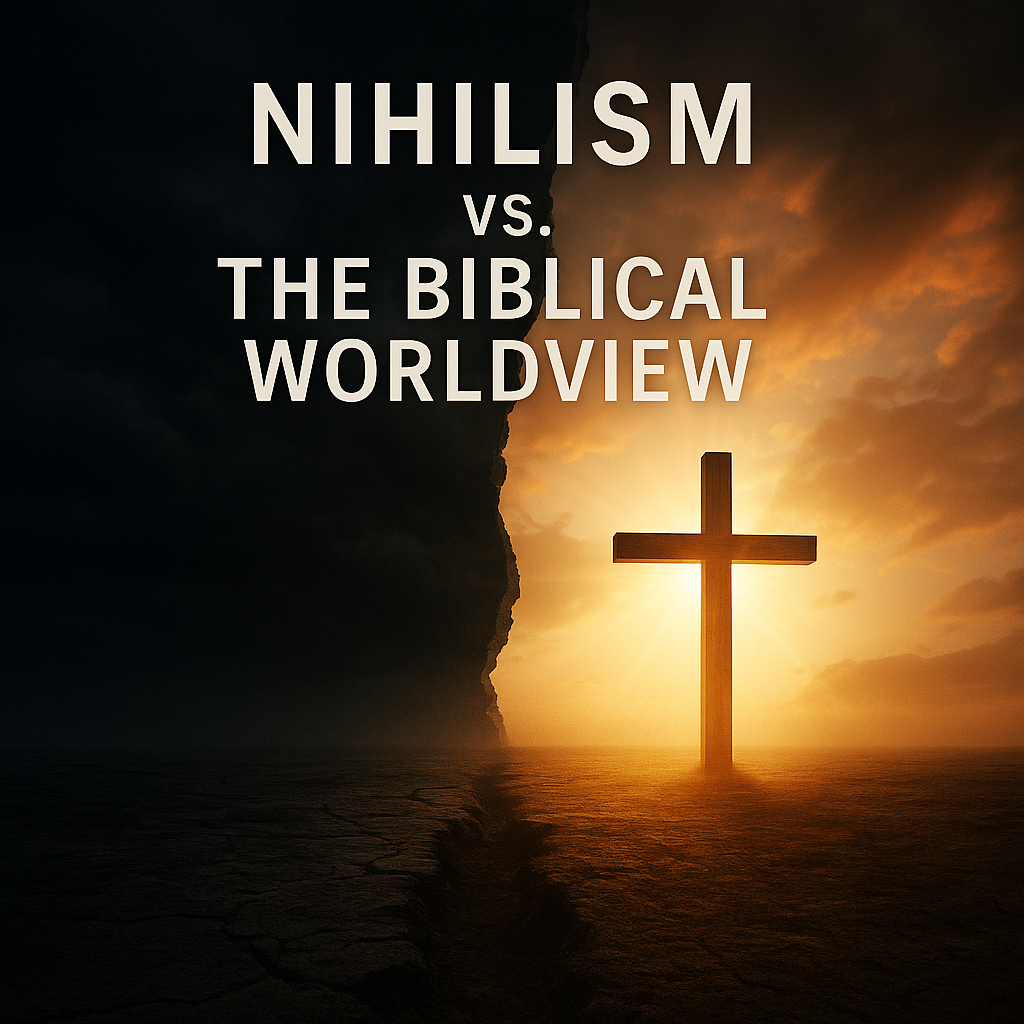
Summary: A Tale of Two Worldviews
Nihilism answers the big questions with silence: nothing, nothing, nothing. The Bible answers them with God: Creator, Image, Purpose, Law, Resurrection. Nihilism leads to despair; Scripture leads to life. As Francis Schaeffer once observed, Christianity is not merely true, it is livable, it alone makes sense of reality as we actually experience it (Schaeffer 1976).
This is why nihilism so often ends in despair or destruction, while a biblical worldview produces hope, responsibility, and endurance. The difference is not small; it is eternal.
Nihilism vs. Hope in Christ
The assassination of Charlie Kirk is a sobering reminder of what happens when meaning collapses. Whether or not Tyler Robinson considered himself a nihilist, his reported rationale echoed the hollow voice of nihilism: life is meaningless, hate is unfixable, destruction is the only option. This is nihilism with blood on its hands.
But the lesson is not confined to one man’s crime. Nihilism seeps through our culture in countless ways:
- When young people confess, “Nothing matters.”
- When entertainment glamorizes chaos.
- When morality is reduced to preference or power.
- When despair whispers that life is not worth living.
At every point, nihilism offers emptiness where God offers fullness. It is, as Paul would say, a “futile mind” and a “darkened understanding” (Eph. 4:17–18, LSB). And like all false worldviews, it ends in death (Rom. 6:23).
The Gospel’s Answer to Nihilism
Against the cry of “nothing,” the Gospel proclaims “Christ.”
- Origin: You were created by God.
- Identity: You bear His image.
- Meaning: You exist to glorify Him.
- Morality: You are accountable to His law.
- Destiny: You face judgment, but in Christ, you can receive resurrection and eternal life.
This is not theoretical. It is the only way life makes sense. As Jesus Himself declared, “I am the way, and the truth, and the life; no one comes to the Father but through Me” (John 14:6, LSB).
A Call to Our Time
The choice before us is stark: nihilism or hope. If life is meaningless, then despair, violence, or apathy are consistent responses. But if God is Creator and Christ is risen, then life is infused with eternal purpose, unshakable morality, and indestructible hope.
For Christians, this moment is not simply a cultural critique, it is a call to discipleship. We must equip the next generation to see through the lies of nihilism and to stand firmly on the truth of God’s Word. We must remind a culture drunk on emptiness that only Christ satisfies. And we must live out the difference, so that our neighbors see hope embodied in our lives. Just as Charlie Kirk did.
Final Word
Nihilism answers the human cry with silence. The biblical worldview answers it with the voice of the living God. In Christ, nothing is wasted, nothing is meaningless, and nothing is lost. Even death itself is swallowed up in victory (1 Cor. 15:54).
That is the difference between “life is meaningless” and “life abundant.” And it is the difference our age most desperately needs to see.
References
Associated Press. 2025. “Prosecutors Seek Death Penalty for Suspect in Charlie Kirk Assassination.” AP News, September 16, 2025. https://apnews.com/article/f541df08a936e06497ee2342296bc398.
Camus, Albert. 1942. The Myth of Sisyphus. Paris: Gallimard.
Jacobi, Friedrich Heinrich. 1799. Jacobi an Fichte. Leipzig: Vogel.
Merriam-Webster. 2025. “Nihilism.” Accessed September 17, 2025. https://www.merriam-webster.com/dictionary/nihilism.
Nietzsche, Friedrich. 1882. The Gay Science. Trans. Walter Kaufmann. New York: Vintage, 1974.
Pratt, Alan. 2020. “Nihilism.” Internet Encyclopedia of Philosophy. Accessed September 17, 2025. https://iep.utm.edu/nihilism/.
Reuters. 2025. “Prosecutors Seek Death Penalty for Suspect in Charlie Kirk Assassination.” Reuters, September 16, 2025. https://www.reuters.com/world/us/prosecutors-seek-death-penalty-suspect-charlie-kirk-assassination-2025-09-16/.
Sartre, Jean-Paul. 1943. Being and Nothingness. Paris: Gallimard.
Schaeffer, Francis. 1976. How Should We Then Live? The Rise and Decline of Western Thought and Culture. Old Tappan, NJ: Revell.
Turgenev, Ivan. 1862. Fathers and Sons. London: Penguin, 1965.
Scripture
- Ecclesiastes 12:13
- Ephesians 4:17–18
- Genesis 1:1, 1:26–27
- John 14:6
- Micah 6:8
- Romans 2:14–15, 6:23
- 1 Corinthians 10:31, 15:17–20, 15:32, 15:54
- Hebrews 9:27
- Revelation 21