
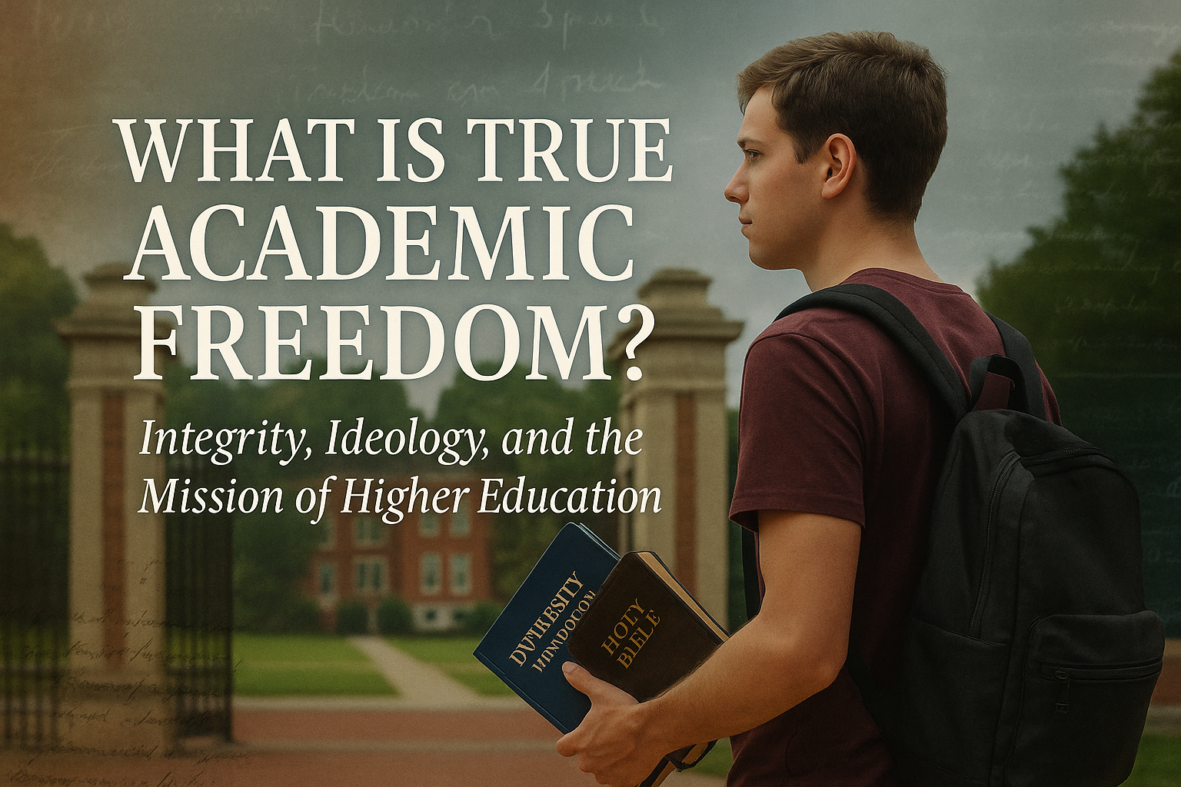
Thesis: True academic freedom anchored in truth and integrity protects both the mission of the institution and the responsibility of the professor. When higher education descends into Critical Theory indoctrination, it violates academic freedom by silencing dissent, forcing conformity, and betraying its calling to seek truth (AAUP 1940; Lowery 2022).
What Academic Freedom Is and Isn’t
Academic freedom has always been a contested ideal, but in today’s climate, it feels like we’ve reached a tipping point. Professors call for liberty to research, teach, and speak without political intrusion. Universities, meanwhile, bear the weighty responsibility to define their mission, shape their curriculum, and steward the public trust. Both claim freedom. Both claim duty. But what happens when those claims collide?
The American Association of University Professors’ 1940 statement offers a defining framework. It upholds professors’ freedom in the classroom when discussing their subject, but cautions against introducing “controversial matter that has no relation to their subject” (AAUP 1940). This isn’t censorship. It’s tethered liberty; freedom ordered toward academic and institutional integrity.
A biblical worldview provides a clarifying lens here. Jesus said, “You will know the truth, and the truth will set you free” (John 8:32). Freedom without truth is deception. The apostle Peter warns us not to “use your freedom as a covering for evil” (1 Peter 2:16). In other words, academic freedom is not a license to preach ideology but a responsibility to pursue truth. Professors are stewards of this responsibility, called to shape minds, not mold disciples of their own worldview (James 3:1). The classroom should echo Paul’s exhortation: “examine everything carefully; hold fast to that which is good” (1 Thess. 5:21, LSB).
The Core Tension: Professors vs. Institutions
This brings us to the first major tension: Who ultimately owns academic freedom: the professor or the institution?
Professors rightly argue they need the space to follow inquiry wherever it leads, to challenge orthodoxy, and to spark intellectual growth. That’s part of what makes higher education valuable. But institutions are not neutral. Every university carries a charter, a mission, a worldview, even the “secular” ones. Institutions also claim academic freedom, the freedom to define their purpose, guard their standards, and shape their faculty in alignment with their identity.
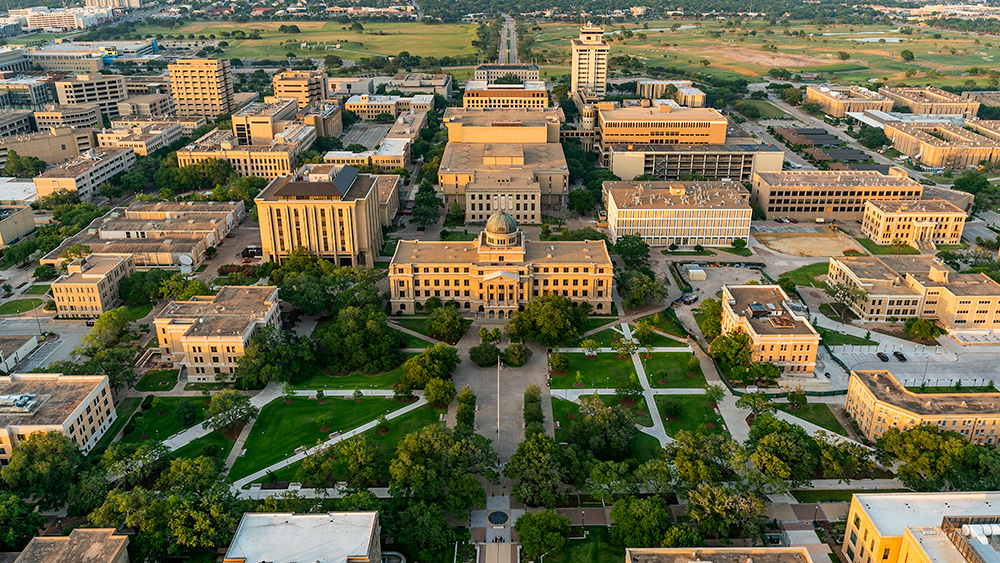
Trouble brews when those freedoms clash. Consider a recent case at Texas A&M. A professor used a children’s literature course to teach gender ideology, sparking administrative review. Leadership determined the lesson fell outside the scope of the catalog description and violated university guidelines on politicization. Was this censorship? Or was it institutional integrity?
This isn’t just about Texas. It’s a broader flashpoint in higher ed. Professors may feel stifled. Institutions may feel hijacked. But academic freedom, rightly ordered, must avoid both extremes: the anarchy of unchecked personal ideology and the authoritarianism of institutional overreach.
The Student Is Not Just a Customer: Rethinking the Education Covenant
Amidst this tug-of-war between professor and institution, a third party often gets overlooked: the student.
In the age of rising tuition and credential inflation, students are often cast as consumers. They’re “paying for a product.” The university becomes a vendor. The degree becomes a commodity. And as any customer knows: “If I’m paying for it, I get to decide what I’m getting.”
It’s a compelling argument, but a deeply flawed one.
Education is not a transaction. It’s a transformation. Students are not buying diplomas. They are entering a formative covenant, a process that involves exposure, challenge, struggle, and change. Real education demands discomfort. It invites intellectual risk. It should involve confronting ideas one might not agree with and learning to wrestle with them, not cancel them.
This doesn’t mean students have no voice. They should expect syllabi that reflect course descriptions, environments free from retaliation, and clear lines between education and indoctrination. But they do not have the right to dictate institutional mission or silence faculty whose views offend them. Education is not affirmation. It is formation.
Carl Trueman diagnoses the danger well: when higher education adopts a therapeutic model, feelings begin to outrank facts, and the pursuit of truth gives way to the demand for comfort (Trueman 2020). That is not education. That is infantilization.
Scripture offers a better model. The pursuit of wisdom is active, hungry, and humble: “Acquire wisdom! Acquire understanding! Do not forget nor turn away from the words of my mouth” (Prov. 4:5). Paul exhorted Timothy to pass on sound doctrine to “faithful men who will be able to teach others also” (2 Tim. 2:2). Education in Scripture is a formational relay, not a customer service desk.
Students, then, are not consumers; they are stewards. They are not purchasing certainty—they are embracing the responsibility of discernment. And in this covenantal framework, academic freedom makes sense. It calls the student, the professor, and the institution into shared accountability before the truth.
Pressures from Accreditation and Funding
If the internal tensions weren’t enough, external forces also pressure academic freedom from all sides.
- Accreditation bodies now often enforce ideological expectations through DEI benchmarks and diversity audits. The intent may be equity, but the effect is sometimes orthodoxy by fiat, redefining freedom as conformity.
- Government funding complicates things further. Title VI mandates or state-level DEI bans place universities in the crosshairs: comply or risk losing financial lifelines. Policy now polices pedagogy.
- Private grants aren’t neutral either. Research dollars often come with philosophical fingerprints, rewarding projects that align with funder priorities and marginalizing those that don’t.
All of this creates an ecosystem where academic freedom is negotiated, not assumed. The temptation is clear: bend to ideology, preserve the funding stream, and let mission drift downstream with the current.
But Proverbs offers a stark reminder: “The rich rules over the poor, and the borrower becomes the lender’s slave” (Prov. 22:7). Universities that sell their soul to accreditation or donors lose the very freedom they claim to defend.
The faithful university must hold the line. Funding must serve truth, not replace it.
Critical Theory as a Test Case
Nowhere is the threat to academic freedom more obvious than in the rise of Critical Theory as campus orthodoxy.
Let’s be clear: Critical Theory can be studied responsibly. It has academic roots worth exploring: Marxism, Horkheimer, Foucault, and Crenshaw. It belongs in political theory, sociology, and legal history. But when it is weaponized as truth rather than a topic, the university becomes a catechism, not a classroom.
Indoctrination is not education. It assumes the conclusion, silences dissent, and enforces allegiance. Students who question it are labeled bigots. Professors who resist it face cancellation. This is not freedom, it’s dogma enforced by institutional pressure.
Consider again the A&M case. A student challenged the gender ideology being presented. Rather than engage in debate, the student was escorted from the room. That’s not academic discourse. That’s ideological expulsion.
As George La Noue observes, “There is a conflict between the traditional concept of academic freedom and the new reality of critical theory indoctrination, which requires faculty conformity and student silence” (La Noue 2021). That is the anti-gospel of the modern university. And it’s costing us dearly.
Ideas have consequences. Bad ideas have victims. And Critical Theory, when elevated to doctrine, has many: students who are shamed into silence, professors who are punished for dissent, and institutions that lose their identity in the fog of cultural pressure.
A Biblical Framework for Freedom
What’s the solution? Not censorship. Not cowardice. Not consumerism.
The solution is to reclaim academic freedom as a biblically-informed, mission-rooted, truth-pursuing covenant.
- Truth is objective. It is not a construct. It is grounded in God’s revelation and evident in creation (Rom. 1:18–20). Education that rejects truth ceases to be education at all.
- Integrity is essential. Universities must live by their stated missions and core convictions, especially when pressured to compromise. “Whoever walks in integrity walks securely” (Prov. 10:9).
- Freedom is stewardship. Professors exercise it before God, students practice it in humility, and institutions guard it with vigilance.
- Discernment is the goal. Christian education is not afraid of ideas; it evaluates them. Critical Theory isn’t ignored; it’s tested. Secularism isn’t banned; it’s weighed. Truth is never afraid of scrutiny.
As I’ve argued elsewhere, the church must not fight Critical Theory by borrowing its weapons. We cannot cancel the cancellers or coerce the coercers and call that victory. We must teach the truth, walk in integrity, and model what freedom rightly used looks like.
Conclusion: A Freedom Worth Defending
The battle for academic freedom is not merely a policy debate. It is a defining test of our age.
- Will professors have the liberty to pursue truth without becoming demagogues of ideology?
- Will institutions protect their missions without becoming enforcers of conformity?
- Will students steward their learning, not as consumers, but as disciples of wisdom?
If academic freedom is reduced to institutional self-preservation or professorial pontification—or worst of all, to mere customer satisfaction—we all lose.
But if academic freedom is reclaimed as freedom in truth, for truth, and with integrity, we might just restore the university to what it was meant to be: a marketplace of ideas, a training ground of discernment, and a servant of truth.
Jesus said, “You will know the truth, and the truth will set you free” (John 8:32). That kind of freedom is worth defending.
References
- American Association of University Professors. 1940. Statement of Principles on Academic Freedom and Tenure.
- Hegar, G. 2025. Statement on ENGL 360, Texas A&M University, September 2025.
- La Noue, George. 2021. “Can Academic Freedom Survive Critical Race Theory?” Law & Liberty, June 10.
- Lowery, Richard. 2022. “The False Choice Between Academic Freedom and Critical Theory Bans.” Texas Public Policy Foundation, February 9.
- National Association of Scholars. 2007. Response to Freedom in the Classroom.
- Reighley, Chris. 2025a. “The Spirit Tested: Texas A&M, Gender Ideology, and the Call to Integrity.” ChrisReighley.com.
- Reighley, Chris. 2025b. “Integrity Tested, Integrity Demanded: A Colson Fellows Framework for TAMU.” ChrisReighley.com.
- Reighley, Chris. 2025c. “Cancel Culture Tested: When Conservatives Borrow Critical Theory’s Tools.” ChrisReighley.com.
- Trueman, Carl. 2020. The Rise and Triumph of the Modern Self.
- Welsh, Mark A. III. 2025. Statement on ENGL 360, Texas A&M University, September 2025.
Related Articles:
The Spirit Tested: Texas A&M, Gender Ideology, and the Call to Integrity
Integrity Tested, Integrity Demanded: A Colson Fellows Framework for TAMU
Cancel Culture Tested: When Conservatives Borrow Critical Theory’s Tools