

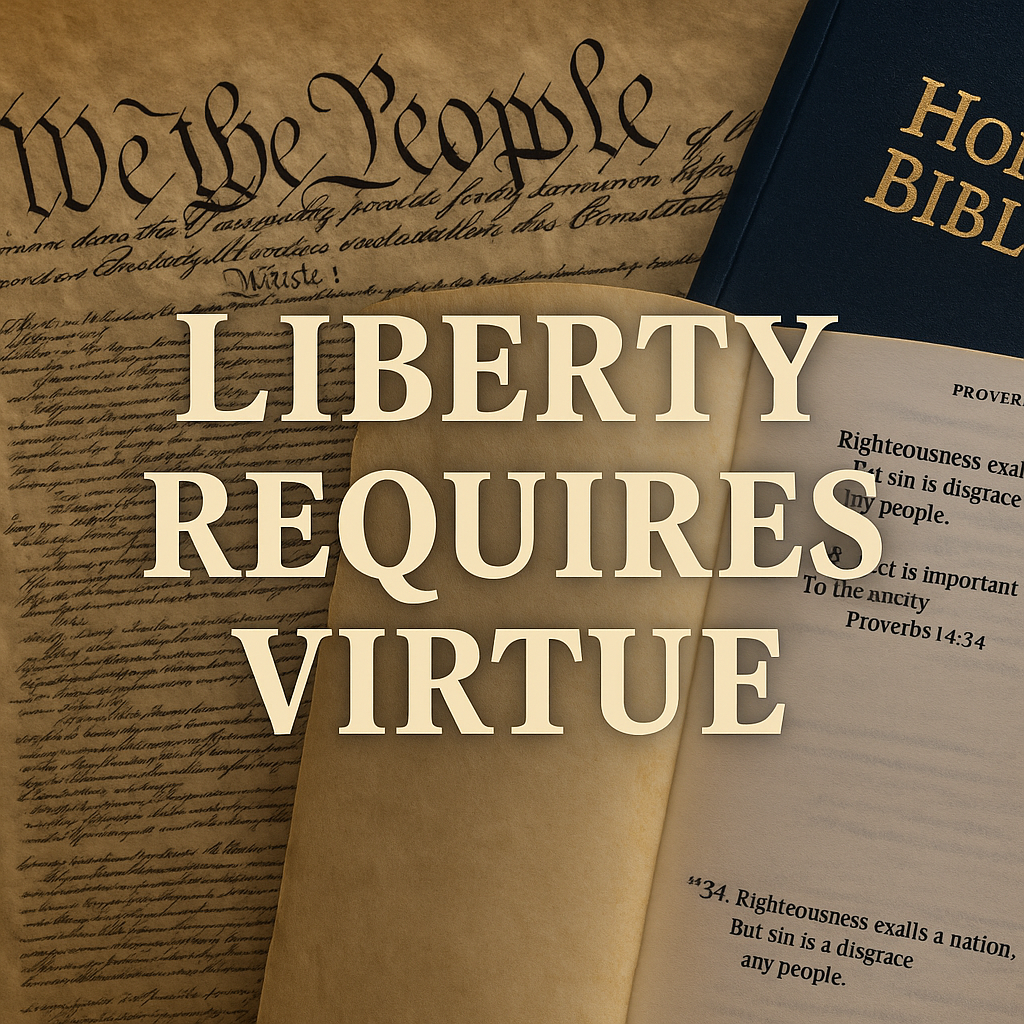
The Fragile Secret of Liberty
John Adams once warned,
“Our Constitution was made only for a moral and religious people. It is wholly inadequate to the government of any other” (Adams 1798).
At the time, his words were not controversial they reflected a broad consensus among America’s founding generation. Today, however, they strike many as almost offensive, even exclusionary. How could the enduring framework of American liberty be tied to something as seemingly subjective as morality, and more specifically, religious belief? Yet for the founders, this was not speculation; it was self-evident truth.
To grasp their perspective, imagine Philadelphia in the summer of 1787. The delegates to the Constitutional Convention debated for weeks under sweltering heat. Tensions rose, tempers flared, and compromise seemed out of reach. Then Benjamin Franklin, hardly a theological radical, rose and called for prayer:
“I have lived, Sir, a long time, and the longer I live, the more convincing proofs I see of this truth that God governs in the affairs of men” (Franklin 1787).
His appeal did not usher in a national church, but it did remind the delegates that no political architecture could stand without moral and spiritual underpinnings. Notably, the Convention did not adopt regular prayers or appoint a chaplain afterward—underscoring moral dependence on God rather than ecclesiastical control.
This conviction was not unique to Adams or Franklin. George Washington, in his Farewell Address, insisted that
“of all the dispositions and habits which lead to political prosperity, religion and morality are indispensable supports” (Washington 1796).
He warned against the “supposition that morality can be maintained without religion,” stressing that free institutions require citizens capable of self-control. The founders knew what Scripture affirms: that the heart is “more deceitful than all else and is desperately sick” (Jer 17:9, LSB). Without virtue to restrain sin, liberty collapses into either anarchy or tyranny.
The early American experience reinforced this truth. From the Mayflower Compact of 1620 pledging to form a civil body politic “for the glory of God, and advancement of the Christian faith” (Mayflower Compact 1620) to the Massachusetts Body of Liberties (1641), which grounded civil law in biblical principle, colonial society assumed that liberty was sustained by virtue, and virtue by religion. Alexis de Tocqueville, visiting in the 1830s, marveled that
“Liberty cannot be established without morality, nor morality without faith” (Tocqueville 1835).
His outside perspective confirmed what the founders already knew: a republic is a fragile arrangement, always at risk if its people lose their moral compass.
Yet here lies the paradox of our age. The very Constitution designed for a “moral and religious people” is now asked to sustain a culture increasingly divorced from shared moral conviction. We celebrate liberty but bristle at virtue. We defend rights but deny the Source from which they come. The result is instability, a nation trying to preserve the fruit of liberty while cutting away the root of morality.
This article will trace how we arrived at this point how a nation built on the conviction that virtue under God is the guardian of freedom slowly drifted into relativism. But before we analyze the drift, we must remember the starting point: America’s founders understood that liberty was never self-sustaining. It was always a fragile trust, resting on the moral fiber of the people.
The Founders’ Conviction: Liberty’s Moral Prerequisite
When America’s founders reflected on the fragile experiment of self-government, they consistently returned to one principle: liberty requires virtue, and virtue requires religion. They did not see this as abstract philosophy but as a practical necessity for a republic. Without moral citizens, the framework of the Constitution would crumble under the weight of human corruption.
George Washington made the point most memorably in his Farewell Address (1796):
“Of all the dispositions and habits which lead to political prosperity, religion and morality are indispensable supports.” He urged his countrymen never to indulge “the supposition that morality can be maintained without religion.”
Washington was not speaking as a sectarian preacher but as a statesman. He believed as Scripture affirms that government could restrain outward crime but could not cultivate inward virtue (Rom 13:3–4). For a people to govern themselves, they had to first be governed by God’s truth.
John Adams expressed this conviction even more bluntly in 1798:
“Our Constitution was made only for a moral and religious people. It is wholly inadequate to the government of any other.”
For Adams, the logic was simple: a republic depends on self-rule, but self-rule is impossible without self-control, and self-control requires moral restraint. He had seen the corrosive effects of unchecked ambition during the Revolution and knew that a nation without virtue would descend into anarchy or invite tyranny.
James Madison, though often celebrated for his constitutional architecture, shared the same anthropology. In Federalist No. 51 he observed,
“If men were angels, no government would be necessary.”
But because men are not angels, government must check ambition with ambition through separated powers. Yet even Madison recognized that paper structures were insufficient if the people themselves abandoned virtue. As he wrote in his 1788 speech to the Virginia ratifying convention,
“To suppose that any form of government will secure liberty or happiness without any virtue in the people, is a chimerical idea.”
Benjamin Franklin, though the least orthodox of the founders, echoed the same principle when he rose at the Constitutional Convention and appealed for prayer. He admitted,
“The longer I live, the more convincing proofs I see of this truth that God governs in the affairs of men” (Franklin 1787).
Franklin’s theology may have been broad, but his political reasoning was sharp: if God does not guide, no constitution can save.
Even Congress, in its earliest acts, wove this assumption into law. The Northwest Ordinance (1787), adopted under the Articles of Confederation and reaffirmed by the First Congress, declared:
“Religion, morality, and knowledge, being necessary to good government and the happiness of mankind, schools and the means of education shall forever be encouraged.”
Here, the legislators linked education not merely to literacy or civic training but to the cultivation of religion and morality the soil from which republican institutions would grow.
This conviction was not simply pragmatic politics; it reflected a deeper worldview shaped by Christianity. The founders, even when diverse in personal faith, shared the biblical understanding of human nature: mankind is created in God’s image (Gen 1:26–27) yet corrupted by sin (Rom 3:23). Because man is fallen, power must be limited and distributed. Because man bears God’s image, he is capable of reason, conscience, and virtue. The balance of liberty and law could only be sustained if citizens were formed by moral discipline.
Thus, when the founders spoke of “religion,” they overwhelmingly meant Christianity as the cultural framework of morality. At the state level, vestiges of establishment remained into the 19th century (e.g., Massachusetts until 1833), even as the federal Constitution barred a national church. They did not require sectarian conformity, nor did they establish a national church, but they assumed that biblical truth shaped conscience and community life. As historian Daniel Dreisbach observes, the founders “read the Bible as a political text” and saw in it both the warning against tyranny and the call to righteousness (Dreisbach 2017).
The American experiment, then, rested on a paradox: a Constitution designed with structural checks against corruption still assumed a citizenry capable of virtue. Washington, Adams, Madison, and Franklin may have differed in theology, but they agreed on this: freedom would survive only if the people were moral, and morality would endure only if anchored in religion. The Constitution was not a machine that could run by itself it was a covenant, dependent on the character of those who lived under it.
The Christian Roots of Virtue: Covenant, Conscience, and Civil Life
If the Founders believed virtue was essential to liberty, the next question is where that virtue came from. Their answer, reflected in charters, state constitutions, and civic practice, was overwhelmingly rooted in the moral vision of Christianity. Even those who hesitated to confess personal orthodoxy recognized that biblical religion supplied the moral framework without which republican government could not endure.
1. The Covenant Tradition
The earliest English settlers carried with them the Puritan and Reformed concept of covenant theology the belief that human communities, like Israel, could enter into binding agreements under God’s authority. The Mayflower Compact(1620) stands as the clearest example: the Pilgrims pledged themselves to form a “civil body politic” “for the glory of God, and advancement of the Christian faith” (Mayflower Compact 1620). This was not a secular social contract but a sacred covenant, uniting political order with religious accountability.
The Fundamental Orders of Connecticut (1639) went further, establishing a written constitution explicitly designed to govern a Christian commonwealth. Historian Mark Noll calls this “the most important early example of the seamless fusion of biblical covenant and political order” (Noll 2002). For these colonists, political legitimacy was not abstract but grounded in the God who rules over nations (Ps 22:28). Puritans treated Israel’s covenant as analogy for ordered community, not as a replacement of Israel; the Church and Israel remain distinct in God’s plan.
2. Biblical Law as the Moral Standard
Colonial codes often incorporated biblical principles directly into civil law. The Massachusetts Body of Liberties (1641) drew heavily from the Ten Commandments, prohibiting idolatry, murder, theft, and adultery, while affirming the sanctity of life, property, and family. These laws assumed that civic order flowed naturally from God’s revealed moral law.
This framework did not mean the colonies perfectly embodied biblical justice persecution of dissenters and other injustices reveal their flaws but it demonstrates the assumption that Scripture provided the standard by which virtue was measured. The founders inherited this conviction, even as they refined it into a more pluralistic context by the late 18th century.
3. Liberty of Conscience
One of Christianity’s most significant contributions to political thought was the doctrine of liberty of conscience. While New England Puritans often struggled to honor dissent, other colonies advanced the idea more clearly. William Penn’s Frame of Government (1682) in Pennsylvania guaranteed freedom of worship, rooted in his Quaker conviction that coercion could not produce true faith. Similarly, Rhode Island under Roger Williams became a haven for Baptists, Quakers, and Jews on the basis of religious liberty.
These practices echoed the New Testament principle that faith cannot be compelled (Acts 5:29; John 4:24). They also reinforced a political truth: if citizens were to practice genuine virtue, it must flow from conviction, not compulsion. As Tocqueville later observed, religion in America “must be regarded as the first of their political institutions” precisely because it shaped conscience without relying on state coercion (Tocqueville 1835). Penn’s 1701 Charter broadened toleration; Rhode Island’s 1663 charter became an early landmark of free exercise.
4. Education and Formation
The colonial link between Christianity and virtue extended into education. Harvard’s founding motto, Veritas Christo et Ecclesiae (“Truth for Christ and the Church”), reflected the belief that knowledge and virtue were inseparable. The Old Deluder Satan Act of 1647 required towns to establish schools so children could read Scripture, thereby resisting ignorance and cultivating moral order. By the time of the Revolution, this educational assumption had carried into the Northwest Ordinance’s declaration that “religion, morality, and knowledge” were necessary for good government (1787).
5. The Founders’ Inheritance
By the 18th century, Enlightenment influences had grown stronger, but the Founders did not abandon the Christian moral heritage they reframed it. Jefferson’s appeal to the Creator in the Declaration of Independence (1776) echoed Genesis 1:26–27, affirming that rights come not from kings but from God. Adams spoke openly of the Ten Commandments as the moral foundation of law. Washington attended services, referenced Providence repeatedly, and saw religion as indispensable to civic life.
Even deists like Franklin, while skeptical of orthodoxy, insisted that Christian virtue was necessary for a free society. As historian Daniel Dreisbach notes, the Bible was “the most frequently cited source in the political discourse of the founding era” (Dreisbach 2017). Whether in sermons, pamphlets, or legislative debates, Scripture provided the categories through which liberty and morality were understood.
Summary
The roots of American virtue were unmistakably Christian. Covenant theology shaped political covenants. Biblical law provided moral standards. Liberty of conscience established the principle of free worship. Education aimed to form moral citizens through Scripture. And the Founders inherited this framework, blending it with English common law and Enlightenment reason.
Thus, when they declared that liberty required morality and morality required religion, “religion” overwhelmingly meant the Christianity that had shaped colonial society for over a century. The soil of the republic was not neutral it was tilled by covenant, watered by biblical law, and fertilized by the conviction that true freedom flows from the God of Scripture.
How the Vision Drifted: From Covenant to Chaos
The founders assumed that liberty required virtue and that virtue rested upon religion. Yet over the past two centuries, America has steadily drifted from this foundation. This erosion was not sudden but gradual, unfolding through intellectual revolutions, cultural upheavals, and legal decisions that collectively displaced Christianity as the moral compass of civic life.
1. Enlightenment Rationalism (1700s–1800s) – Truth Without Revelation
The Enlightenment prized reason and science, often at the expense of revelation. In Europe, philosophers such as Voltaire and Rousseau championed human autonomy over divine authority. While American founders like Washington and Adams retained a broadly Christian framework, others like Jefferson leaned toward deism, affirming a Creator but denying biblical revelation.
Jefferson’s famous Jefferson Bible (c. 1804), which removed miracles and supernatural elements, illustrates this shift: morality was retained, but Christ’s deity and resurrection were discarded. Yet Scripture warns that removing the gospel’s power leaves only a hollow form of religion (2 Tim 3:5). The result was a moral shell ethics without theology, civic virtue without covenant accountability.
Though the early Republic still relied heavily on Christianity, seeds of rationalism were planted. Liberty began to be seen as grounded not in God’s Word but in human reason a subtle but foundational shift.
2. Industrialization and Individualism (1800s) – Success Over Virtue
The 19th century brought rapid industrial growth, westward expansion, and urbanization. These forces shifted American priorities from community virtue to personal success. Where the Puritan town meeting once centered civic life around shared moral commitments, the factory and the frontier fostered mobility, wealth-seeking, and rugged individualism.
This was not inherently evil hard work and innovation are commended in Scripture (Prov 22:29). Yet without a covenantal moral anchor, individualism slid into self-interest. Churches struggled to keep pace, often fragmenting under denominational disputes or being displaced by the pursuit of prosperity. Alexis de Tocqueville foresaw this danger in the 1830s: “As long as the majority is undecided, discussion is carried on; but as soon as its decision is irrevocably pronounced, everyone is silent, and friends and enemies seem to draw near.” He noted that liberty without faith drifts toward conformity or chaos (Tocqueville 1835).
Thus, industrialization shifted the nation’s center of gravity: prosperity became the measure of success, not virtue. Liberty was redefined as economic freedom more than moral responsibility. Countercurrents of revival and voluntary societies sought to re-anchor civic life in Christian virtue.
3. Progressivism and Secularization (1900s) – Faith as Private
The early 20th century introduced the Progressive movement, which sought to apply scientific methods to social problems. While noble in intent, this often meant sidelining religious authority in favor of “neutral” expertise. Schools shifted from cultivating virtue to imparting technical knowledge. The Bible, once seen as the textbook of morality, was increasingly dismissed as irrelevant to modern life.
The Scopes Trial (1925) symbolized this transition. Although ostensibly about evolution, it became a cultural referendum on whether the Bible still held authority in public life. Even though the anti-evolution side technically won the case, it lost the cultural battle. Christianity was mocked as backward, while secular modernism gained prestige.
By mid-century, the Supreme Court accelerated secularization. In Engel v. Vitale (1962), the Court struck down state-sponsored prayer in schools, followed by Abington v. Schempp (1963), which banned Bible reading. These decisions redefined public education: religion was no longer seen as the foundation of morality but as a private affair. Yet the Northwest Ordinance (1787) had insisted that “religion, morality, and knowledge” were necessary for good government. By the 1960s, this triad was severed.
4. Moral Relativism (1960s–1990s) – Truth as Preference
The Sexual Revolution of the 1960s–70s embodied the rejection of Christian morality in favor of personal autonomy. What had once been governed by biblical standards marriage, sexuality, family was now redefined by individual choice. The mantra “do your own thing” mirrored the biblical indictment of Israel: “Everyone did what was right in his own eyes” (Judg 21:25).
This era also witnessed the rise of legal relativism: abortion was legalized in Roe v. Wade (1973), redefining life itself as subject to personal decision. The moral consensus of Christian teaching on human dignity and sexuality fractured. Liberty was untethered from virtue; it became license.
Francis Schaeffer warned in How Should We Then Live? (1976) that Western civilization, having abandoned its Christian base, would drift toward both chaos and authoritarian control. He argued that once absolutes are lost, law becomes arbitrary dictated by majority whim or elite power.
5. Postmodernism (1990s–Present) – Truth as Power
By the late 20th century, postmodern thought took relativism further: truth was no longer just preference but a tool of power. Concepts like “your truth” and “my truth” fractured any shared moral framework. The biblical worldview, once the foundation for civic order, was cast as oppressive.
This spirit was codified in cultural flashpoints: debates over same-sex marriage culminating in Obergefell v. Hodges(2015), the normalization of gender ideology, and the rise of critical theories that redefine morality as social construct. Without a transcendent moral anchor, government increasingly becomes the arbiter of identity, rights, and morality itself.
Romans 1 describes this trajectory: when truth is suppressed, God “gives them over” to disordered desires and futile thinking (Rom 1:18–28). A society that rejects God’s moral order cannot sustain liberty; it dissolves into confusion and conflict.
Summary of the Drift
- Enlightenment Rationalism hollowed out faith into ethics without revelation.
- Industrialization & Individualism replaced covenant virtue with economic success.
- Progressivism & Secularization privatized religion, removing it from public life.
- Moral Relativism made truth subjective and liberty license.
- Postmodernism reduced truth to power, destabilizing civic order.
What began as a republic “for a moral and religious people” slowly transformed into a culture suspicious of morality itself. The result is a nation trying to preserve the fruit of liberty after cutting away the root of virtue.
The Present Crisis: Liberty Without Virtue
America now finds itself in a paradox. We loudly proclaim liberty as our highest value, but we increasingly deny the moral and religious foundation that makes liberty possible. The Constitution still stands as a legal framework, but the cultural soil that once nourished it virtue rooted in Christianity has eroded. What remains is freedom without responsibility, rights without duties, and government without moral consensus. America often betrayed its professed standards, most grievously in slavery and racial injustice, revealing our need for, not the dispensability of, biblical virtue.
1. Polarization Without Shared Morality
The founders assumed citizens shared a common moral vision shaped by biblical law and natural rights. Today, those assumptions are gone. Instead of one standard of justice, there are competing moral universes. One side frames liberty in terms of personal autonomy especially in matters of sex, identity, and expression. The other side appeals to inherited traditions and biblical absolutes. The result is polarization that cannot be bridged by compromise, because the disagreement is not over policy details but over the very definition of truth and morality.
This collapse of shared moral language leaves public discourse hollow. As Isaiah warned, “Woe to those who call evil good, and good evil; who substitute darkness for light and light for darkness” (Isa 5:20, LSB). When a culture loses the ability to agree on good and evil, civil debate becomes impossible and coercion becomes inevitable.
2. Government Expansion to Fill the Moral Vacuum
The Constitution was designed for a self-governing people. If citizens lacked virtue, external constraints could not save them. As Adams warned, the Constitution was “wholly inadequate” for an immoral people. Yet rather than recover virtue, modern society has asked government to step into the vacuum.
- Where families fail, welfare programs expand.
- Where communities collapse, federal regulation grows.
- Where virtue is absent, law multiplies.
But laws cannot produce character. They can restrain crime, but they cannot form conscience. As the founders understood, liberty requires self-control, and self-control requires moral formation. Without that, a society either collapses into chaos or drifts into authoritarianism. We now see both tendencies: lawlessness in the streets and overreach from the state.
3. The Cost to Liberty
As government expands, liberty contracts. Speech codes, regulatory overreach, and social coercion illustrate how fragile freedom becomes when virtue is lost. Ironically, a society that rejects biblical morality in the name of liberty soon finds liberty itself unsustainable. The apostle Paul’s words ring true: “For you were called to freedom, brothers; only do not turn your freedom into an opportunity for the flesh, but through love serve one another” (Gal 5:13, LSB). Freedom divorced from virtue collapses into bondage either to sin or to the state.
4. The Cultural Confusion of the Moment
The consequences of liberty without virtue are all around us:
- A generation uncertain of what truth even means.
- Institutions unable to define marriage, life, or gender.
- Public debates more about silencing opponents than persuading them.
- Leaders who prize power over principle.
Like Israel in the time of the judges, our society increasingly lives as if “everyone did what was right in his own eyes”(Judg 21:25, LSB). The result is not freedom but fragmentation.
Summary
The present crisis is not primarily political or economic it is moral and spiritual. America has tried to retain the machinery of liberty after severing it from its Christian foundation. But a Constitution designed for a virtuous people cannot sustain a culture bent on vice. Liberty without virtue is like a tree with severed roots: it may appear strong for a season, but it is destined to fall.
Theological Analysis: The Chain of Liberty
The founders’ conviction that liberty requires morality, and morality requires religion, was not merely political instinct. It reflected biblical truth about God, man, and society. Scripture provides the framework for understanding why liberty is fragile without virtue, and why virtue cannot be sustained apart from the truth of God.
1. Liberty Requires Self-Government
The genius of the American experiment was not unlimited freedom but ordered liberty. The apostle Paul reminds believers: “For you were called to freedom, brothers; only do not turn your freedom into an opportunity for the flesh, but through love serve one another” (Gal 5:13, LSB). True freedom is not license to indulge sin but the capacity to live under God’s rule.
For a republic, this means citizens must govern themselves restraining passions, honoring conscience, and practicing justice. If individuals lack self-control, external control must grow. The founders knew what Proverbs teaches: “Like a city that is broken into and without a wall is a man who has no control over his spirit” (Prov 25:28, LSB). Without self-government, both people and nations collapse into disorder.
2. Self-Government Requires Virtue
Self-control is not automatic. Human beings are fallen. As Jeremiah declared, “The heart is more deceitful than all else and is desperately sick; who can know it?” (Jer 17:9, LSB). Left to themselves, people pursue power, pleasure, and pride. This is why Madison could write in Federalist No. 51, “If men were angels, no government would be necessary.”
Virtue justice, honesty, fidelity, charity is therefore essential. Without it, liberty disintegrates. The founders did not assume virtue would appear naturally; they assumed it must be cultivated. John Adams spoke candidly: “Public virtue cannot exist in a nation without private, and public virtue is the only foundation of republics.” The Bible agrees: “Righteousness exalts a nation, but sin is a disgrace to any people” (Prov 14:34, LSB).
3. Virtue Requires Truth Anchored in God
Here lies the heart of the matter: if virtue is merely relative defined by culture, majority, or personal preference it cannot sustain liberty. Virtue requires an unchanging moral standard. That standard is God Himself. As Isaiah declared, “The LORD is our lawgiver, the LORD is our king; He will save us” (Isa 33:22, LSB). The founders’ ‘laws of nature and of nature’s God’ cohere with Scripture: natural law is real, and Scripture authoritatively clarifies it.
Christianity uniquely grounds morality in the character of God revealed in Scripture. The Ten Commandments, the Sermon on the Mount, and the fruit of the Spirit (Gal 5:22–23) provide objective standards that transcend culture. Without this anchor, virtue becomes arbitrary and collapses under pressure.
Romans 1 warns what happens when societies suppress this truth: God “gives them over” to dishonorable passions and depraved minds (Rom 1:24–28). The result is a culture where liberty is destroyed by vice, and government expands in vain attempts to restrain it.
4. The Logic of the Chain
The theological chain can be summarized as follows:
- Liberty requires self-government.
- Self-government requires virtue.
- Virtue requires truth.
- Truth requires God.
Cut one link, and the chain breaks. Reject God, and truth becomes relative. Without truth, virtue evaporates. Without virtue, self-government fails. Without self-government, liberty cannot survive.
This is why the founders insisted that the Constitution was designed only for a moral and religious people. They recognized that no system of checks and balances could preserve liberty if the people themselves rejected God’s truth.
Summary
The founders’ political wisdom was inseparable from biblical theology. They saw that liberty is not self-sustaining but rests on a chain of divine truth. Remove God from the foundation, and the entire edifice collapses. Their warnings echo the Scriptures: only righteousness exalts a nation, and only truth sets men free (John 8:32).
The Call to Recovery: Replanting the Roots of Liberty
If liberty cannot endure without virtue, and virtue cannot endure without God, then America’s crisis is not fundamentally political but spiritual. Laws may restrain outward evil, but only transformed hearts can sustain a republic of free people. The founders knew this, and Scripture confirms it. The urgent question, then, is how recovery can happen not through nostalgia for the past, but through renewal rooted in Christ.
1. Remember the Foundation
Recovery begins by remembering what has been forgotten: liberty depends on righteousness. Washington warned that to imagine morality can be maintained without religion is to risk the collapse of political prosperity. John Adams declared the Constitution inadequate for an irreligious people. Their wisdom was not original; it echoed Proverbs 14:34: “Righteousness exalts a nation, but sin is a disgrace to any people” (LSB).
Christians must recover the courage to say what Scripture affirms and what the founders assumed: freedom is a fragile gift, dependent on virtue grounded in God’s truth. Without it, liberty rots from within.
2. Restore Virtue Through Discipleship
The Church’s mission is not to seize political power but to make disciples (Matt 28:19–20). Yet disciple-making is precisely how virtue is restored in a society. The fruit of the Spirit love, joy, peace, patience, kindness, goodness, faithfulness, gentleness, self-control (Gal 5:22–23) are the very qualities necessary for self-government.
Political activism has its place, but no election can replace the slow, steady work of spiritual formation. As Os Guinness has argued, “The ultimate threat to freedom does not come from foreign enemies but from ourselves, from the corruption of character within” (Guinness 2012). Recovery begins when families, churches, and communities recommit to forming men and women whose liberty is governed by virtue.
3. Reclaim the Public Square With Humility
Christians must resist both withdrawal and triumphalism. Withdrawal leaves the culture to collapse; triumphalism confuses the Church’s mission with building a theocracy. Instead, believers are called to engage the public square with conviction and humility, declaring with Paul, “We destroy speculations and every lofty thing raised up against the knowledge of God” (2 Cor 10:5, LSB).
This means speaking truth about life, marriage, justice, and morality not as angry partisans, but as faithful witnesses. It means showing that the gospel, not government, is the true source of human flourishing. And it means modeling in our own communities the kind of virtue we hope to see restored nationally.
4. Recommit to Education and Formation
The founders linked education with religion and morality because they knew free institutions cannot endure without informed and virtuous citizens. Today’s schools often divorce knowledge from wisdom. Recovery requires parents, churches, and Christian institutions to rebuild education on biblical foundations. Deuteronomy 6:6–7 remains the model: “These words, which I am commanding you today, shall be on your heart. And you shall teach them diligently to your sons and shall speak of them when you sit in your house and when you walk by the way and when you lie down and when you rise up” (LSB).
The future of liberty rests on whether the next generation knows not only how to succeed but how to live under God.
5. Revival as the Only Lasting Hope
Ultimately, no program or policy can restore what has been lost. Only the gospel can change hearts. Only the Spirit can awaken a people to repentance. History shows that when nations reach the brink, God often works through revival the First and Second Great Awakenings both reinvigorated virtue and civic life.
America’s hope is not in reclaiming a golden age but in Christ, who alone can forgive sin, renew virtue, and sustain true freedom. As Jesus declared: “If the Son makes you free, you will be free indeed” (John 8:36, LSB).
Summary
The call to recovery is simple but demanding: remember the foundation, restore virtue through discipleship, reclaim the public square with humility, recommit to biblical education, and pray for revival. America does not need a new Constitution it needs a renewed conscience. Liberty will wither unless re-rooted in the truth of God. But if the Church is faithful, the same God who raised nations in the past can revive His people today.
Closing Illustration & Appeal: Remembering the Covenant
In 1620, the Pilgrims huddled in the cramped cabin of the Mayflower, battered by storms, far from home, facing an unknown wilderness. Before they set foot on shore, they paused to write words that still echo across centuries: “Having undertaken, for the glory of God, and advancement of the Christian faith, and the honour of our king and country, a voyage to plant the first colony in the northern parts of Virginia…” (Mayflower Compact 1620). With quill and parchment, they covenanted to form a civil body politic under God.
Two hundred years later, John Adams warned that the Constitution could not endure without a moral and religious people. Another two centuries have passed, and his warning has become prophecy. We are now testing whether liberty can survive when virtue has been severed from faith.
The question before us is not merely political; it is covenantal. Will we live as a people who remember that freedom is fragile, a trust sustained only by righteousness? Or will we continue to chase liberty while discarding the very foundation on which it rests? Scripture gives the answer: “The wicked will return to Sheol, even all the nations who forget God. But the needy will not always be forgotten, nor the hope of the afflicted perish forever” (Ps 9:17–18, LSB).
There is hope. God is not finished with His people. Revival is not impossible. The same gospel that turned the world upside down in the first century, that shaped covenants in the seventeenth, that birthed awakenings in the eighteenth and nineteenth, remains the power of God unto salvation today (Rom 1:16). The question is not whether God can restore virtue, but whether His people will walk faithfully in repentance, discipleship, and courageous witness.
Liberty without virtue is unsustainable; virtue without God is impossible. But with Christ, true freedom is promised: “If the Son makes you free, you will be free indeed” (John 8:36, LSB). America may have forgotten this covenant, but the Church must not. We are called to live as salt and light, to proclaim Christ crucified and risen, and to embody the truth that righteousness exalts a nation.
The Pilgrims signed their compact with trembling hands, but firm conviction. Adams spoke with blunt urgency. Washington warned with sober clarity. Now it falls to us: will we remember what they knew that freedom is not sustained by paper and ink, but by hearts transformed under God’s truth?
The covenant is before us still. The question is whether we will live it.
References
Primary Sources
- Adams, John. 1798. Address to the Officers of the First Brigade of the Third Division of the Militia of Massachusetts. October 11, 1798.
- Franklin, Benjamin. 1787. Speech at the Constitutional Convention, June 28. In The Records of the Federal Convention of 1787, ed. Max Farrand. New Haven: Yale University Press.
- Jefferson, Thomas. 1776. The Declaration of Independence. July 4, 1776.
- Jefferson, Thomas. c. 1804. The Jefferson Bible: The Life and Morals of Jesus of Nazareth.
- Madison, James. 1788. Speech at the Virginia Ratifying Convention. June 20, 1788.
- Madison, James. 1788. Federalist No. 51. In The Federalist Papers, ed. Clinton Rossiter. New York: Signet Classics, 2003.
- Mayflower Compact. 1620. In Documents Illustrative of American History, ed. Howard, George Elliott. New York: Macmillan, 1910.
- Northwest Ordinance. 1787. An Ordinance for the Government of the Territory of the United States, North-West of the River Ohio. July 13, 1787.
- Tocqueville, Alexis de. 1835. Democracy in America. Trans. Henry Reeve. New York: Vintage Classics, 1990.
- Washington, George. 1796. Farewell Address. September 19, 1796.
Scripture (Legacy Standard Bible)
- Genesis 1:26–27.
- Proverbs 14:34.
- Proverbs 25:28.
- Isaiah 5:20.
- Isaiah 33:22.
- Jeremiah 17:9.
- Judges 21:25.
- Psalm 9:17–18.
- Romans 1:16, 18–32.
- Romans 3:23.
- Romans 13:1–4.
- Galatians 5:1, 13, 22–23.
- John 8:32, 36.
- 2 Corinthians 10:5.
- Deuteronomy 6:6–7.
Secondary Sources
- Dreisbach, Daniel L. 2017. Reading the Bible with the Founding Fathers. New York: Oxford University Press.
- Guinness, Os. 2012. A Free People’s Suicide: Sustainable Freedom and the American Future. Downers Grove, IL: InterVarsity Press.
- Noll, Mark A. 2002. America’s God: From Jonathan Edwards to Abraham Lincoln. New York: Oxford University Press.
- Schaeffer, Francis A. 1976. How Should We Then Live? Old Tappan, NJ: Revell.
Legal Cases
- Engel v. Vitale, 370 U.S. 421 (1962).
- Abington School District v. Schempp, 374 U.S. 203 (1963).
- Roe v. Wade, 410 U.S. 113 (1973).
- Obergefell v. Hodges, 576 U.S. 644 (2015).
Recommended Reading
If this has stirred your thinking, here are some books and classics that can help you dig deeper into the connection between liberty, virtue, and faith:
- Daniel Dreisbach, Reading the Bible with the Founding Fathers
A careful look at how Scripture shaped the political thought of America’s founders. - Os Guinness, A Free People’s Suicide
A prophetic exploration of why freedom cannot survive without virtue and faith. - Francis Schaeffer, How Should We Then Live?
A classic tracing the rise and decline of Western culture and the role of biblical truth. - Mark Noll, America’s God
A historian’s deep dive into how theology shaped early American political thought. - Alexis de Tocqueville, Democracy in America
A timeless outsider’s view of how religion and morality sustained the American experiment. - George Washington, Farewell Address (1796)
Still one of the most important warnings about the indispensable role of religion and morality.