My July 4th Reflection on Freedom, Providence, and True Protection
The crackle of fireworks fills the air, mingling with the smoky scent of brisket and ribs on the grill. Flags ripple in the summer breeze. Children chase each other across lawns lit by sparklers. And somewhere between the fireworks and the feasting, a question lingers in my heart each Independence Day:
What are we really celebrating?
Is it merely the signing of a document in 1776? The victory at Yorktown? The gift of liberty?
Or is there something deeper, something that stirs the soul, something that reaches beyond red, white, and blue bunting and down into the promises of God Himself?
Of all the messages I’ve had the privilege to preach, one remains especially close to my heart: Psalm 91: An American Promise, shared at Rolling Hills Community Church on July 2, 2017. That sermon wasn’t just a history lesson—it was a reminder that behind our independence lies a far greater dependence on the providence of God.
When I revisit Psalm 91 around this time each year, I’m reminded of how God’s Word speaks across the centuries, from ancient Israel to colonial America to the complexities of our own age.
The Declaration’s Echo of Heaven
Let’s step back, beyond the fireworks and festivities, to that July day in 1776. In a room heavy with the scent of ink and wax, fifty-six men signed their names to what could have been their death warrants. The Declaration of Independence wasn’t just a political statement—it was, in many ways, a prayer.
“We hold these truths to be self-evident, that all men are created equal, that they are endowed by their Creator with certain unalienable Rights…”
Note that word: Creator. These men, for all their flaws and human frailty, declared that their rights were not granted by kings or parliaments—but by God.
I often reflect on the fact that many of these signers were trained in seminaries. Men like John Witherspoon, a clergyman and signer, and others who had been elders, founders of Bible societies, and students of Scripture. They understood that the liberties they sought could never be secured apart from divine aid.
And so they invoked “the protection of Divine Providence” as they committed themselves to a cause that would cost toil, treasure, and blood.
The Soldier’s Psalm and Washington’s Story
That brings us to Psalm 91, often called the Soldier’s Psalm. It opens with a promise that rings as true today as it did then:
“He who dwells in the shelter of the Most High will abide in the shadow of the Almighty. I will say to Yahweh, ‘My refuge and my fortress, My God, in whom I trust!’” (Psalm 91:1–2, LSB)
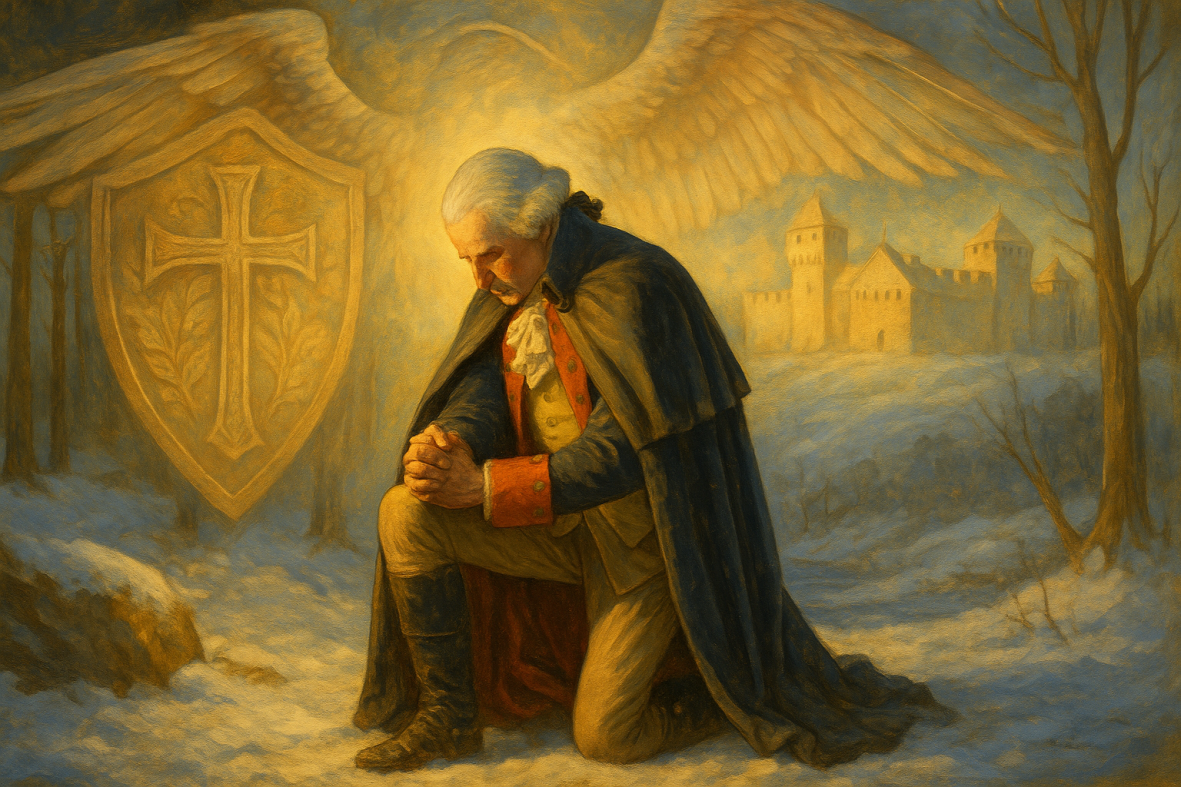
And in the providence of God, there was perhaps no figure in our early history who embodied that trust more than George Washington.
Let me take you back to July 1755—twenty-one years before independence. Washington, then a young officer in the French and Indian War, found himself in a deadly ambush. Bullets tore through his coat. Horses fell beneath him. Soldiers on every side dropped like wheat before the scythe.
Yet he rode on—untouched.
Years later, Washington would write to his brother of “the miraculous care of Providence” that had preserved his life. And when he returned to those Pennsylvania woods fifteen years after the battle, an aged Native chief sought him out—not as an enemy, but as a witness to God’s hand.
“The Great Spirit protects that man and guides his destinies. He will become the chief of nations, and a people yet unborn will hail him as the founder of a mighty empire.”
Fireworks, Freedom, and True Refuge
Every Fourth of July, we celebrate the victory of liberty. But let’s not forget:
🕊 The first liberty many sought on these shores was religious liberty—the freedom to worship God without fear.
🛡 The true refuge that sustained them was not found in walls or weapons, but under the shadow of the Almighty.
Psalm 91 goes on:
“You will not be afraid of the terror by night, or of the arrow that flies by day… For He will give His angels charge concerning you, to guard you in all your ways.” (Psalm 91:5, 11, LSB)
It’s a psalm for soldiers—but also for farmers, shopkeepers, parents, and preachers. It’s a psalm for anyone who calls on the name of the Lord.
What This Means for Us Today
If I could whisper one truth into the fireworks-filled air of this Independence Day, it would be this:
👉 The greatest freedom is the freedom Christ gives.
Governments may rise and fall. Rights may be granted or taken. But if the Son makes you free, you are free indeed (John 8:36).
👉 The greatest protection is the protection of God.
Washington understood this. Our founders declared it. And we are wise to remember it.
👉 The greatest promise is salvation.
Psalm 91 ends not with military victory or national pride, but with God’s voice:
“Because he has loved Me, therefore I will deliver him… I will rescue him and honor him. With a long life I will satisfy him and let him see My salvation.” (Psalm 91:14–16, LSB)
That’s the promise that outshines every firework, that waves higher than every flag.
A Prayer for Our Nation
Lord God, as we mark another year of American independence, we thank You for the blessings You have poured out on this land. But more than that, we thank You for the eternal freedom You offer in Christ. Teach us to abide in Your shadow. Protect us as a people. And may this nation—and we who call it home—turn our hearts to You, our true refuge and King. In Jesus’ name, Amen.
This post draws from one of my favorite sermons to preach—Psalm 91: An American Promise. I invite you to listen to the full message here.
And if you’d like to explore more about Christian citizenship, faith, and cultural engagement, check out my Shoe Leather Gospel podcast.
So this Fourth of July, as you savor the brisket and watch the sky light up, remember: The truest promise of Independence Day isn’t found in documents or declarations. It’s found in the shadow of the Almighty, where the believer dwells secure—come what may.